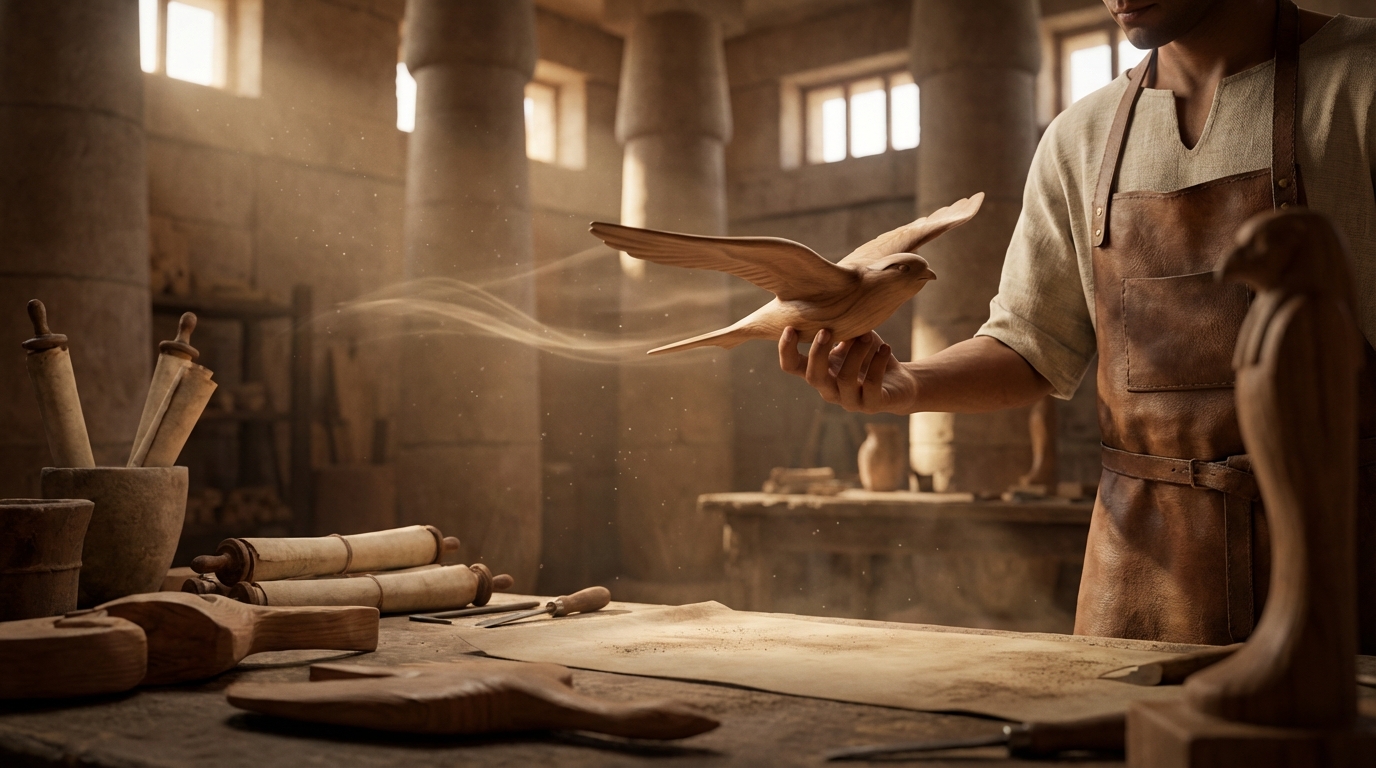
The Saqqara Bird
A 2,200-year-old wooden artifact with design features that no bird has—and no toy needs
The Object
"This object has characteristics of an aircraft model—the wing profile, the vertical tail fin, the proportions. These are not features found on birds or conventional votive objects."
— Dr. Khalil Messiha, physician and model aircraft enthusiast, 1969Discovered in 1898 in a tomb at Saqqara, Egypt, and initially catalogued as a simple bird figurine (artifact #6347), the Saqqara Bird sat unremarked in the Egyptian Museum in Cairo for over seventy years. It is carved from sycamore wood, measures approximately 18 centimeters in wingspan, weighs 39 grams, and dates to roughly 200 BCE.
In 1969, Dr. Khalil Messiha, who happened to be both a physician and an experienced model aircraft builder, noticed something peculiar about object #6347: its tail fin is vertical, like an airplane's rudder. Birds have horizontal tail feathers. No known bird figurine from ancient Egypt—and there are many—has a vertical tail. Additionally, the wings have a slight dihedral angle and an airfoil-like cross section, features associated with aerodynamic lift.
The Aerodynamic Debate
"Our CFD analysis of the Saqqara Bird geometry shows it would not achieve sustained flight in its current form. However, the addition of a horizontal tailplane—a component that may have broken off—transforms the aerodynamic profile significantly."
— Simon Sanderson, aerodynamics researcher, 2006 studyIn 2006, aviation and aerodynamics researchers built scaled replicas and subjected the Saqqara Bird's geometry to computational fluid dynamics (CFD) analysis. The results were mixed: in its current form, without a horizontal stabilizer, the object cannot sustain powered flight. The wing loading is too high for a simple glider.
But here's where it gets interesting. There is a slot at the base of the vertical tail that appears designed to hold a horizontal tailplane—a component that is now missing. When researchers added a horizontal stabilizer to the model and re-ran the analysis, the aerodynamic performance improved dramatically. With the right proportions, the modified design could function as a viable glider. A 2023 follow-up CFD study confirmed that the base design alone doesn't fly—but couldn't rule out that the original object was part of a larger, more complete assembly.
Strange Design Choices
"If it's a toy bird, it's the only one in the entire Egyptian archaeological record with a vertical tail fin and no legs."
— Martin Gregorie, free-flight model aircraft designer, 2002The conventional explanation is that the Saqqara Bird is simply a toy or a weathervane shaped like a falcon or other bird sacred to the Egyptians. This is entirely plausible. Ancient Egyptians carved many bird figurines. But the conventional explanation has to account for several oddities: the vertical tail fin, the absence of painted feather details (common on other bird figurines), the absence of legs, and the wing profile that more closely resembles an engineered airfoil than an organic wing shape.
None of these features are deal-breakers individually. Together, they form a pattern that is, at minimum, curious. Why would a craftsman building a toy bird make design choices that align more closely with aeronautical engineering than with ornithology?
The Saqqara Bird is a perfect example of how a single, small artifact can open a rabbit hole of questions. It almost certainly cannot fly as-is. But its design features are genuinely unusual for a bird figurine, and the missing tailplane slot is hard to explain away.
What's most interesting isn't the object itself but the context. The ancient Egyptians were master observers of the natural world. They watched birds obsessively—falcons, ibises, and vultures were sacred animals with deep religious significance. Is it possible that centuries of watching birds soar led some curious craftsman to experiment with the principles of flight? Not to build a flying machine—just to understand why birds stay aloft?
We know the Chinese were experimenting with kites by the 5th century BC. We know the Egyptians had sophisticated woodworking, an understanding of wind (they were master sailors), and the intellectual curiosity to investigate the natural world. A small wooden model—a glider prototype, tested from a rooftop or cliff—is not outside the realm of possibility. It would leave almost no archaeological trace.
The Saqqara Bird may be nothing more than a toy falcon with an unusual tail. Or it may be evidence that someone in Ptolemaic Egypt was thinking about aerodynamics two thousand years before the Wright brothers. The object alone can't tell us which. But it can make us wonder.
Sources & Further Reading
- Messiha, Khalil — "African Experimental Aeronautics: A 2,000-Year-Old Model Glider" (1983) — see also Saqqara Bird (Wikipedia)
- Sanderson, Simon — Aerodynamic analysis and CFD study of the Saqqara Bird (2006)
- Gregorie, Martin — "The Saqqara Bird—An Evaluation," Free Flight Quarterly (2002)
- Coppens, Philip — "The Saqqara Bird: Out-of-Place Artifact?" (2009)
- Egyptian Museum, Cairo — Artifact #6347, Saqqara excavation (1898)