The Dendera Light
Ancient Egyptian reliefs that look disturbingly like electrical devices—coincidence or something stranger?
The Reliefs
"The object depicted bears a striking resemblance to a Crookes tube—a type of cathode ray tube used in early electrical experiments."
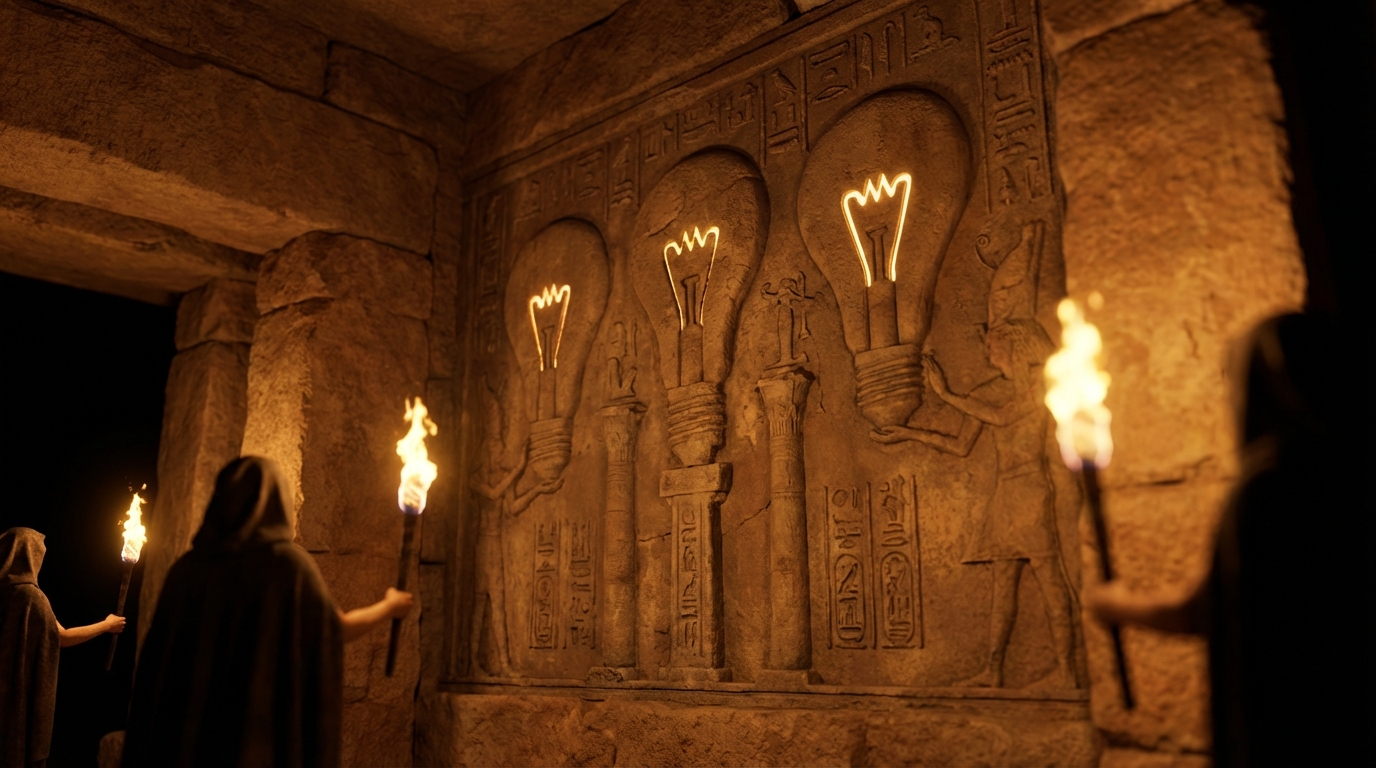
— Peter Krassa & Reinhard Habeck, Das Licht der Pharaonen (Light of the Pharaohs), 1992Deep inside the Hathor Temple at Dendera, Egypt—in a cramped crypt that most tourists never see—a series of stone reliefs depict something that has baffled researchers since their rediscovery in the 19th century. Carved into the limestone walls are large, elongated objects that look, to modern eyes, unmistakably like oversized light bulbs.
Each "bulb" features a serpentine filament inside a bulbous glass-like enclosure, emerging from what appears to be a socket or base. Thick, cable-like lines run from the base to a box-like structure that resembles a power source. A pillar beneath—interpreted by some as a "Djed column"—looks remarkably like an insulator.
The Electrical Theory
"We constructed a working model based on the Dendera reliefs. When evacuated and connected to a power source, the bulb-shaped vessel produced a glowing discharge—visible light."
— Walter Garn, electrical engineer, experiments documented at the Vienna Institute, 2003In 2003, Austrian electrical engineer Walter Garn built a replica based on the dimensions and proportions shown in the Dendera reliefs. Using a hand-blown glass vessel, a gas mixture, and a high-voltage source, he produced a visible glow discharge—essentially recreating a primitive cathode ray tube. The experiment demonstrated that the depicted object could function as an electrical lighting device if built to the shown specifications.
Proponents of the electrical theory point to a persistent puzzle in Egyptology: there is virtually no soot on the ceilings of deep Egyptian tombs and temples. The interiors are decorated with vivid, detailed paintings that required excellent visibility to create. If the Egyptians used oil lamps or torches—the only lighting sources conventionally attributed to them—where is the soot residue? Mirrors reflecting sunlight could work in simple corridors, but the Dendera crypts are deep, winding passages where reflected sunlight cannot reach.
The Conventional Explanation
"The relief represents a well-known Egyptian mythological motif: the lotus flower giving birth to the serpent, a symbol of creation and regeneration."
— Wolfgang Waitkus, Die Texte in den unteren Krypten des Hathortempels von Dendera, 1997Mainstream Egyptologists interpret the Dendera reliefs as mythological scenes depicting lotus flowers birthing serpents—a creation motif common in Egyptian art. The "bulb" is a lotus bloom. The "filament" is a serpent emerging from the flower. The "cable" is a stem. The "Djed column" is exactly that—a Djed pillar, symbol of stability and Osiris's backbone.
This interpretation fits comfortably within known Egyptian iconography. But it doesn't fully explain why these particular depictions look so different from every other lotus-and-serpent motif in Egyptian art. The proportions are wrong for a lotus. The "serpent" doesn't coil or behave like serpents in comparable reliefs. And the "Djed column" appears in a functional, structural role rather than a purely symbolic one.
The Dendera Light occupies a frustrating middle ground. The electrical interpretation is speculative and unsupported by direct physical evidence—no ancient wiring, no glass vessels, no electrodes have been found in any Egyptian archaeological context. The mythological interpretation is academically sound but arguably incomplete—it doesn't account for the unique visual features that set these reliefs apart from conventional Egyptian art.
What makes this mystery endure is the soot problem. Egyptian artisans created some of the most detailed and vivid paintings in human history, deep inside rock-cut tombs with no natural light. The paintings show no evidence of smoke damage. Copper mirrors lose reflective efficiency rapidly and cannot redirect light around multiple corners into deep chambers. Oil lamps produce copious soot. Something doesn't add up.
Perhaps the answer is mundane—maybe the Egyptians used a type of smokeless lamp we haven't identified, or cleaning methods that removed soot traces. Or perhaps the artisans worked in short shifts, minimizing residue. But the Dendera reliefs invite a more provocative question: what if the ancient Egyptians discovered something about light that we haven't given them credit for?
Sources & Further Reading
- Krassa, Peter & Habeck, Reinhard — Das Licht der Pharaonen (1992) — see also Dendera light (Wikipedia)
- Waitkus, Wolfgang — Die Texte in den unteren Krypten des Hathortempels von Dendera (1997)
- Garn, Walter — Cathode ray tube replication experiments, Vienna (2003)
- Childress, David Hatcher — Technology of the Gods (2000)
- Cauville, Sylvie — Dendara: Les chapelles osiriennes (1997) — see also Dendera Temple complex (Wikipedia)