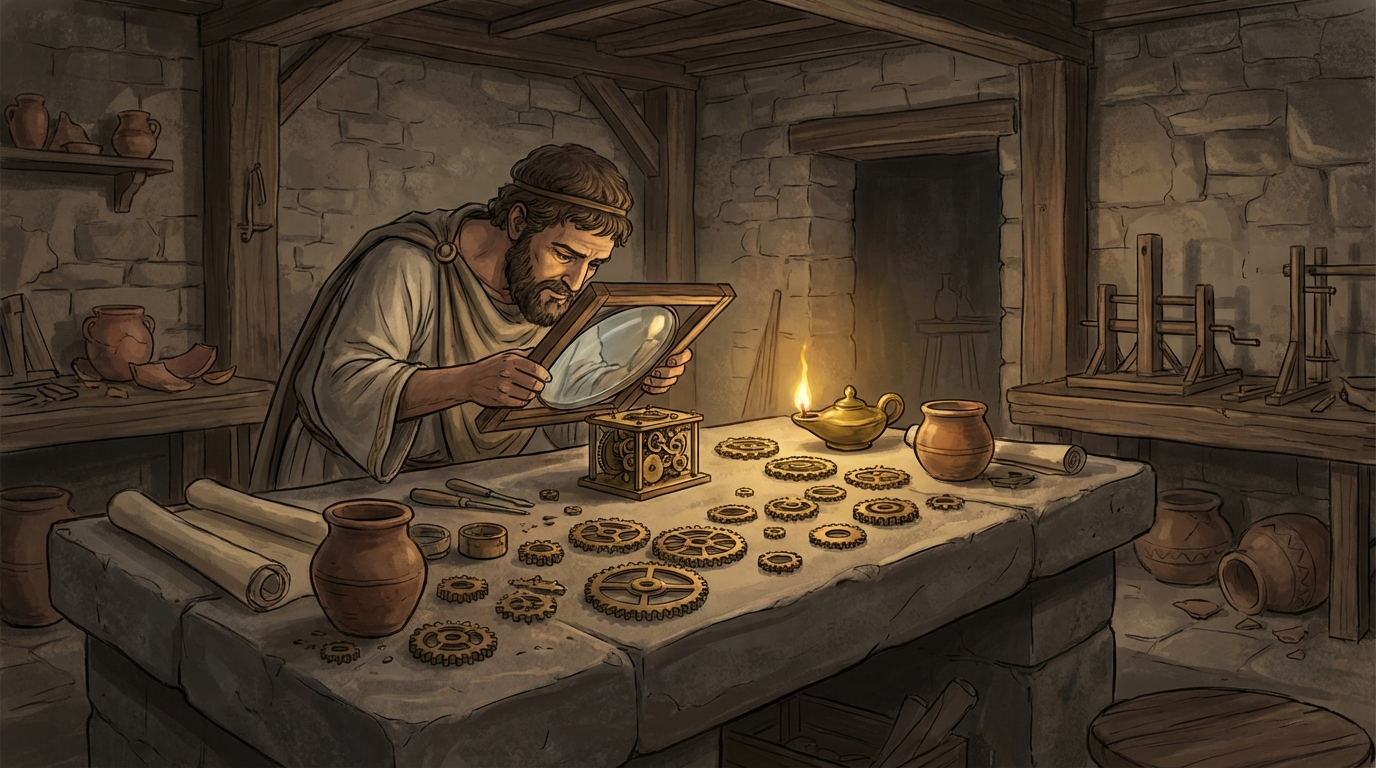
The Antikythera Mechanism
An ancient Greek computer that shouldn't exist—and the terrifying question of what else we've lost
Pulled from the Deep
"Nothing like this instrument is preserved elsewhere. Nothing comparable to it is known from any ancient scientific text or literary allusion."
— Derek J. de Solla Price, "Gears from the Greeks," Transactions of the American Philosophical Society, 1974In 1901, sponge divers off the coast of the tiny Greek island of Antikythera hauled up corroded lumps of bronze from a Roman-era shipwreck dating to roughly 70–60 BC. At first, nobody understood what they were looking at. The fragments sat in the National Archaeological Museum of Athens for decades, dismissed as unremarkable corroded metal.
It wasn't until the 1950s that physicist Derek de Solla Price began to grasp what the fragments truly were: the remains of a sophisticated mechanical computer, built with at least 30 interlocking bronze gears, capable of predicting solar and lunar eclipses, tracking the positions of the five known planets, and computing the dates of the Olympic Games.
A Thousand Years Ahead of Its Time
"The Antikythera mechanism is more complex than any known device for at least a millennium afterwards."
— Alexander Jones, A Portable Cosmos: Revealing the Antikythera Mechanism, 2017The mechanism tracked the Metonic cycle—the 19-year pattern by which the phases of the moon repeat on the same dates. It modeled the Saros cycle of 223 lunar months used to predict eclipses. It even accounted for the elliptical orbit of the moon using a pin-and-slot mechanism that reproduced lunar anomaly with remarkable precision. All of this in a device the size of a shoebox.
After the Antikythera Mechanism, nothing of comparable mechanical complexity appears in the historical record until medieval European astronomical clocks—over a thousand years later. This isn't a gradual gap. It's an abyss. One day, someone in the ancient Greek world was building precision gear trains. Then, for a millennium, the knowledge simply... vanished.
The Real Question
"If the ancient Greeks had the technology to build the Antikythera mechanism, what else could they build that didn't survive?"
— Tony Freeth, Antikythera Mechanism Research Project, University College London, 2021X-ray tomography in 2005 revealed inscriptions hidden inside the corroded fragments—essentially a user manual etched into the bronze plates. The text references astronomical concepts from Babylonian, Egyptian, and Greek traditions, suggesting the mechanism drew on centuries of accumulated knowledge from multiple civilizations.
Here is the thought that should keep you up at night: we only have this device because a ship sank. If that particular Roman cargo vessel had completed its voyage, the mechanism would have been used, eventually broken, and its bronze recycled—as happened to virtually every other bronze artifact from antiquity. We would have no idea it ever existed.
The Antikythera Mechanism is not a mystery in the usual sense. We know what it is. We know, broadly, how it works. The mystery is the silence around it. Where are the others? There must have been others—you don't build something this sophisticated as a one-off. There were workshops, apprentices, earlier prototypes, later refinements. All gone.
Ancient sources hint at mechanical wonders: Archimedes reportedly built a planetarium that Cicero personally examined, describing gears that moved the sun, moon, and planets. Heron of Alexandria described automata powered by steam, water, and pneumatics. These weren't myths. The Antikythera Mechanism proves that the technical skill to build such things absolutely existed.
What we're looking at, when we look at this corroded lump of bronze gears, is proof that our model of technological progress is wrong. Knowledge doesn't only accumulate. It can be lost on a civilizational scale. Libraries burn. Cities fall. Craft traditions die with their last practitioners. The Antikythera Mechanism survived by pure chance. How many equally remarkable devices didn't?
That's the real mystery: not what this device is, but what it represents—the visible tip of an iceberg of lost knowledge, most of which we will never recover.
Sources & Further Reading
- Price, Derek J. de Solla — "Gears from the Greeks," Transactions of the American Philosophical Society (1974)
- Freeth, Tony et al. — "A Model of the Cosmos in the Ancient Greek Antikythera Mechanism," Scientific Reports (2021)
- Jones, Alexander — A Portable Cosmos: Revealing the Antikythera Mechanism (2017)
- Marchant, Jo — Decoding the Heavens: A 2,000-Year-Old Computer (2008)
- Freeth, Tony et al. — "Decoding the Ancient Greek Astronomical Calculator," Nature (2006)