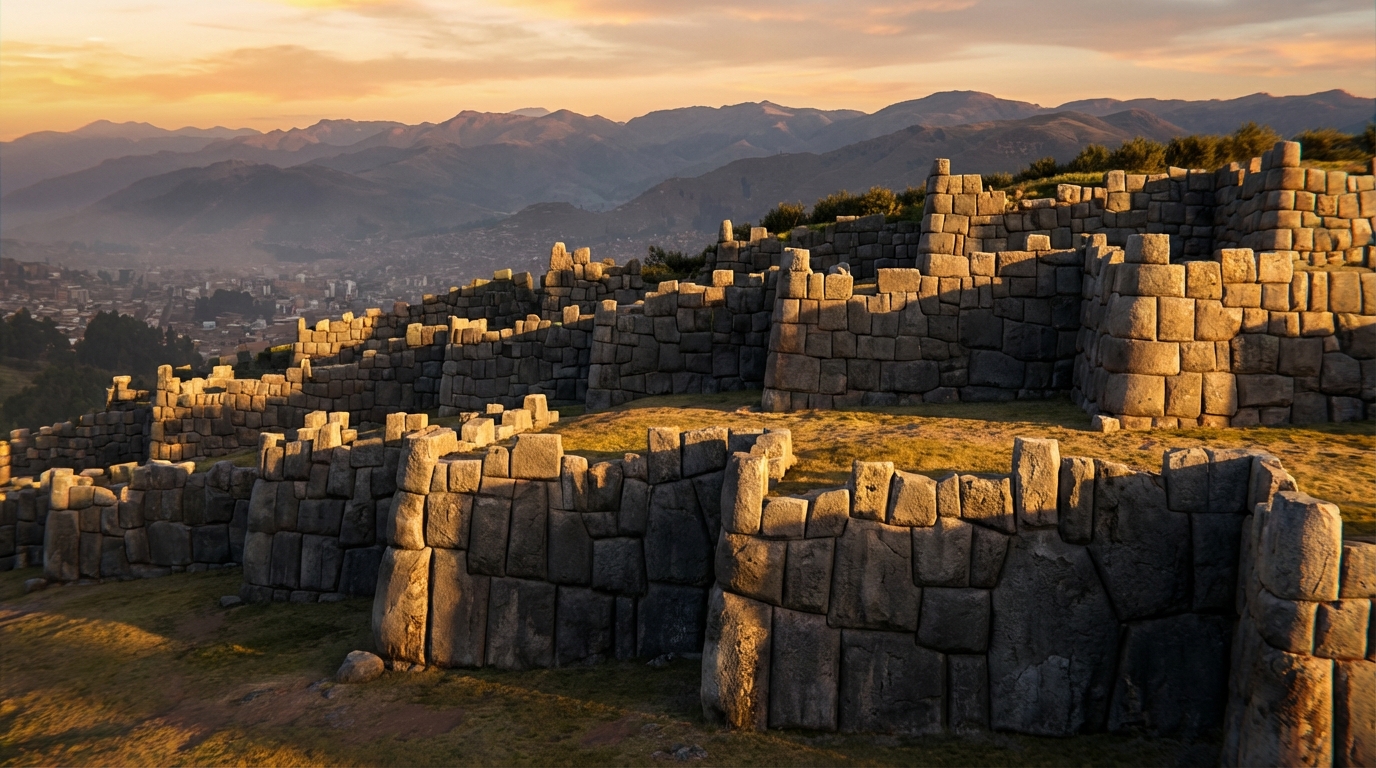
Sacsayhuamán
200-ton boulders cut into jigsaw shapes, fitted without mortar, and standing after 500 years of earthquakes
The Walls
"This fortress surpasses the constructions known as the seven wonders of the world. For in the case of a long broad wall like that of Babylon, or the Colossus of Rhodes... one can see clearly how the work was executed. But it is indeed beyond the power of imagination to understand how these Indians, lacking all knowledge of devices, engines, and tools, could have cut, dressed, raised, and lowered great rocks."
— Inca Garcilaso de la Vega, Royal Commentaries of the Incas, 1609Overlooking the city of Cusco, Peru, at an altitude of 3,700 meters, stands Sacsayhuamán—a massive stone complex built by the Inca Empire in the 15th century. Its most striking feature is three tiers of zigzag walls stretching over 400 meters, composed of enormous limestone and andesite blocks. The largest stones weigh an estimated 200 tonnes and stand over 8 meters tall.
The walls use polygonal masonry—each block is a unique, irregular shape, yet every stone fits against its neighbors with such precision that a sheet of paper cannot be inserted between them. No mortar, no cement, no adhesive of any kind. Just stone against stone, held in place by gravity and the perfection of the fit.
Earthquake-Proof
"In the devastating 1650 earthquake that destroyed most of colonial Cusco, the Spanish cathedral collapsed while the Inca walls of Sacsayhuamán remained standing. The same pattern repeated in the 1950 earthquake."
— John Hemming, The Conquest of the Incas, 1970Peru sits on the Pacific Ring of Fire, one of the most seismically active regions on Earth. Cusco has been hit by devastating earthquakes repeatedly throughout its history. In 1650, a massive earthquake destroyed most of the colonial Spanish buildings in the city, including the cathedral. The Inca walls survived. In 1950, another major earthquake leveled modern structures throughout Cusco. The Inca walls survived again.
The reason is the polygonal masonry itself. Because each stone is a unique, interlocking shape, the walls behave like a three-dimensional jigsaw puzzle during seismic activity. The stones shift slightly, absorbing the energy of the earthquake, then settle back into place. The inward lean of the walls (they tilt slightly toward the hillside) adds further stability. This isn't primitive construction—it's sophisticated seismic engineering, achieved five centuries before earthquake-resistant building codes.
The Method Mystery
"Trial fitting of polygonal blocks this size would require moving 200-tonne stones into position, checking the fit, removing them, adjusting, and repositioning—repeatedly. The logistics are staggering."
— Jean-Pierre Protzen, Inca Architecture and Construction at Ollantaytambo, 1993Jean-Pierre Protzen spent years studying Inca stonework and demonstrated that the surface finishing could be achieved with pounding stones—hard river cobbles used to hammer the softer limestone into shape. But the fitting process remains a puzzle. Each stone was shaped to match its unique neighbors in three dimensions. Given that the stones weigh up to 200 tonnes, the trial-and-error fitting process implied by conventional methods would require moving each block into position, checking the fit against adjacent stones, removing it, reshaping, and repositioning—over and over.
Some researchers have proposed that the Inca used full-scale templates carved from lighter materials. Others suggest a scribing technique where each stone's contact surface was marked against its neighbor using a plumb line. But no definitive explanation accounts for how 200-tonne blocks were manipulated with the precision needed to achieve joints measured in fractions of a millimeter.
The Spanish conquistadors who first saw Sacsayhuamán were so impressed—and so threatened—that they systematically dismantled much of it, using the stones to build their colonial churches and houses. What we see today is a fraction of the original structure. Contemporary accounts describe towers, underground chambers, and additional wall courses that have been completely destroyed. The ruins we marvel at are the leftovers—too large for the Spanish to move.
What survives tells us something profound about Inca engineering philosophy. Where European builders used mortar to compensate for imprecise cutting, the Inca eliminated the weakness entirely. No mortar means no mortar to crack, crumble, or erode. The walls are literally as strong as the stone they're made of. Five hundred years of earthquakes, rain, freeze-thaw cycles, and human vandalism have not separated the joints.
The Inca had no written language, no iron tools, and no wheeled vehicles. They organized labor through the mit'a system—a rotational labor tax that could mobilize tens of thousands of workers. They had generations of accumulated stone-working knowledge, passed down orally from master to apprentice. They had time, patience, and an empire's worth of resources.
Is that enough to explain Sacsayhuamán? Perhaps. But standing before those walls, watching the afternoon light play across joints so tight they look welded, it's hard not to wonder if we're missing something. The Inca clearly knew things about working stone that we don't fully understand. The walls are proof that knowledge doesn't require writing to be profound.
Sources & Further Reading
- Protzen, Jean-Pierre — Inca Architecture and Construction at Ollantaytambo (1993)
- Hemming, John — The Conquest of the Incas (1970)
- Garcilaso de la Vega, Inca — Royal Commentaries of the Incas (1609)
- Hyslop, John — Inka Settlement Planning (1990)
- Gasparini, Graziano & Margolies, Luise — Inca Architecture (1980)