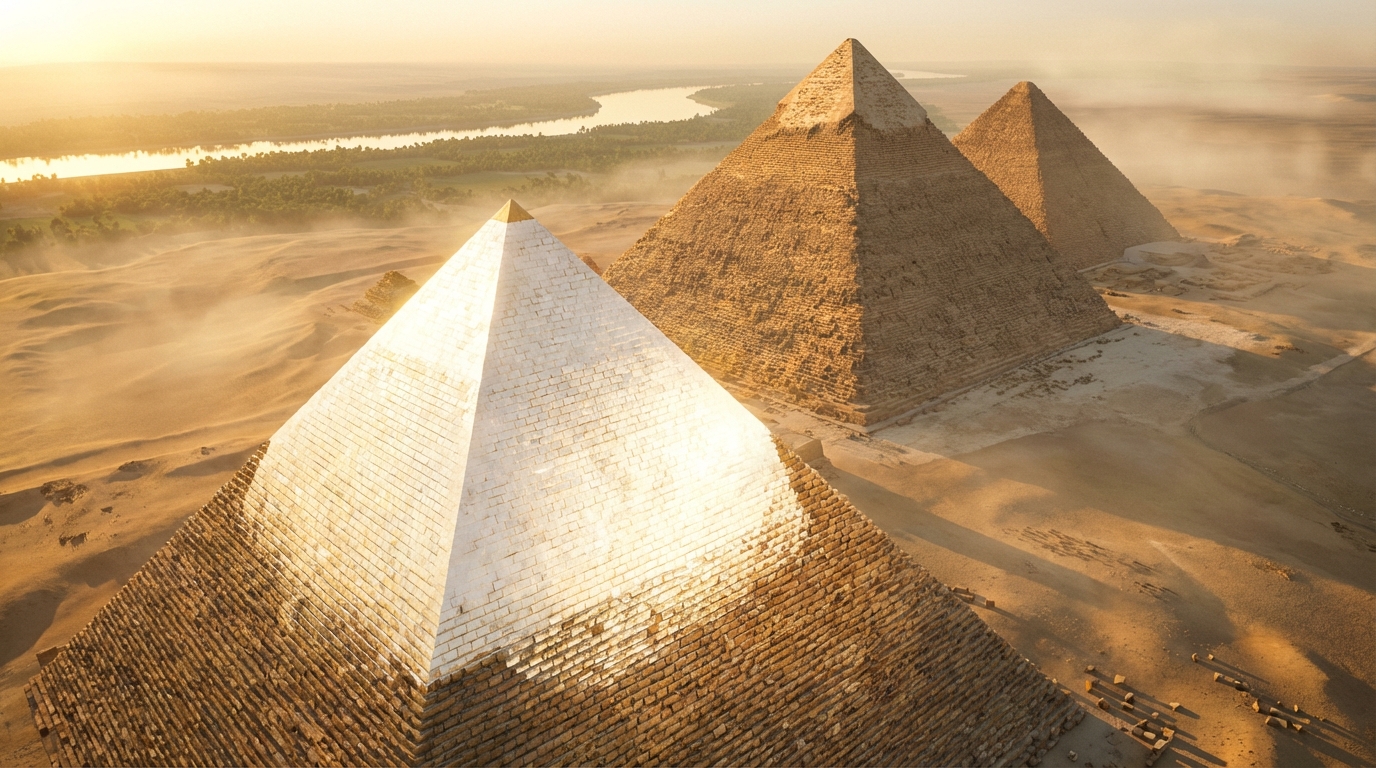
The Great Pyramid of Giza
2.3 million blocks. Aligned to true north within 3.4 arcminutes. No surviving plan explains how.
The Numbers
"The base of the Great Pyramid is level to within just 2.1 centimeters across its entire 230-meter length—an accuracy of less than 0.01%. This is extraordinary for any construction, let alone one built 4,500 years ago."
— W.M.F. Petrie, The Pyramids and Temples of Gizeh, 1883The Great Pyramid of Giza, built during the reign of Pharaoh Khufu (circa 2560 BC), remains one of the most precisely engineered structures ever created. The numbers are staggering: approximately 2.3 million limestone and granite blocks, with an average weight of 2.5 tonnes each. Total weight: roughly 6 million tonnes. Original height: 146.6 meters (taller than the Statue of Liberty). Base perimeter: 921 meters, accurate to within centimeters on each side.
The base is aligned to true north with an error of only 3.4 arcminutes—a precision that wasn't matched until the construction of the Royal Observatory at Greenwich in 1675. The four sides of the base are equal to within 4.4 centimeters over their 230-meter lengths. The right angles at the corners are accurate to within 2 arcminutes. These are not rough approximations. This is precision engineering.
The Construction Timeline
"If the Great Pyramid was built in 20 years, as Herodotus reported, the builders would have had to quarry, transport, and place one block every 2 to 3 minutes, working 10 hours a day, 365 days a year."
— Craig B. Smith, How the Great Pyramid Was Built, 2004Herodotus, writing 2,000 years after the pyramid was built, claimed it took 20 years to construct with 100,000 workers. Modern estimates suggest a workforce of 20,000–30,000 (based on the workers' village excavated by Mark Lehner and Zahi Hawass), which makes the timeline even more challenging. Twenty years means placing an average of one block every few minutes, continuously, for two decades.
The interior granite blocks are even more remarkable. The King's Chamber contains granite beams weighing up to 80 tonnes, transported from Aswan—over 800 kilometers south. They were quarried, shaped to precise dimensions, transported by river, and raised to a height of 60 meters inside the pyramid. The relieving chambers above the King's Chamber contain nine granite slabs, each weighing between 25 and 80 tonnes, stacked to distribute the enormous weight of the pyramid above.
What We Don't Know
"Despite two centuries of study, we still do not have a fully convincing, detailed engineering model for the construction of the Great Pyramid. Every proposed method encounters significant practical objections."
— Giulio Magli, Architecture, Astronomy and Sacred Landscape in Ancient Egypt, 2013No ancient Egyptian document describes how the pyramid was built. Not one. We have administrative papyri (the Wadi al-Jarf papyri, discovered in 2013) that describe the logistics of transporting limestone blocks by boat—a crucial piece of evidence. But we have nothing describing the actual construction method: how the blocks were raised, how the alignment was achieved, how the interior chambers were constructed.
The leading theories—external ramps, internal ramps (Jean-Pierre Houdin's theory), and various lever-based systems—all have significant problems at scale. External ramps would need to be enormous, requiring nearly as much material as the pyramid itself. Internal ramps are ingenious but difficult to confirm without destructive testing. Every proposed method works well for small pyramids; none has been conclusively demonstrated for the full 146-meter height of the Great Pyramid.
The Great Pyramid is perhaps the most studied building on Earth, and it remains the most enigmatic. We know who built it (Khufu), approximately when (circa 2560 BC), and roughly why (as a royal tomb, though even this is debated). What we don't know is how—not in the broad sense (we understand the general principles), but in the precise, engineering-specification sense that would allow us to replicate it.
Consider just the alignment problem. To orient the base to true north within 3.4 arcminutes, the builders needed to identify true north with extraordinary accuracy—likely using stellar observations. But they also needed to transfer that astronomical alignment to a ground survey covering 5.3 hectares, maintaining accuracy across the entire site. This requires surveying instruments and techniques that are never depicted in any Egyptian art or described in any Egyptian text.
The 2013 discovery of the Wadi al-Jarf papyri gave us the journal of Merer, an inspector who oversaw a team transporting limestone blocks to Giza by boat. These are the oldest papyri ever found in Egypt, and they confirm the massive logistical operation behind pyramid construction. But Merer describes transportation, not building methods. The crucial engineering knowledge—how the blocks were raised, how the precision was achieved—remains undocumented.
Perhaps the most unsettling fact about the Great Pyramid is this: it was built at the beginning of the Egyptian pyramid-building tradition, not at its peak. Later pyramids are smaller, less precise, and more prone to collapse. The Great Pyramid wasn't the culmination of a learning curve. It was the high point, achieved almost immediately, followed by a long decline. That's not how technology usually works.
Sources & Further Reading
- Petrie, W.M. Flinders — The Pyramids and Temples of Gizeh (1883)
- Lehner, Mark — The Complete Pyramids (1997)
- Smith, Craig B. — How the Great Pyramid Was Built (2004)
- Tallet, Pierre — Les papyrus de la Mer Rouge (Wadi al-Jarf papyri) (2017)
- Magli, Giulio — Architecture, Astronomy and Sacred Landscape in Ancient Egypt (2013)