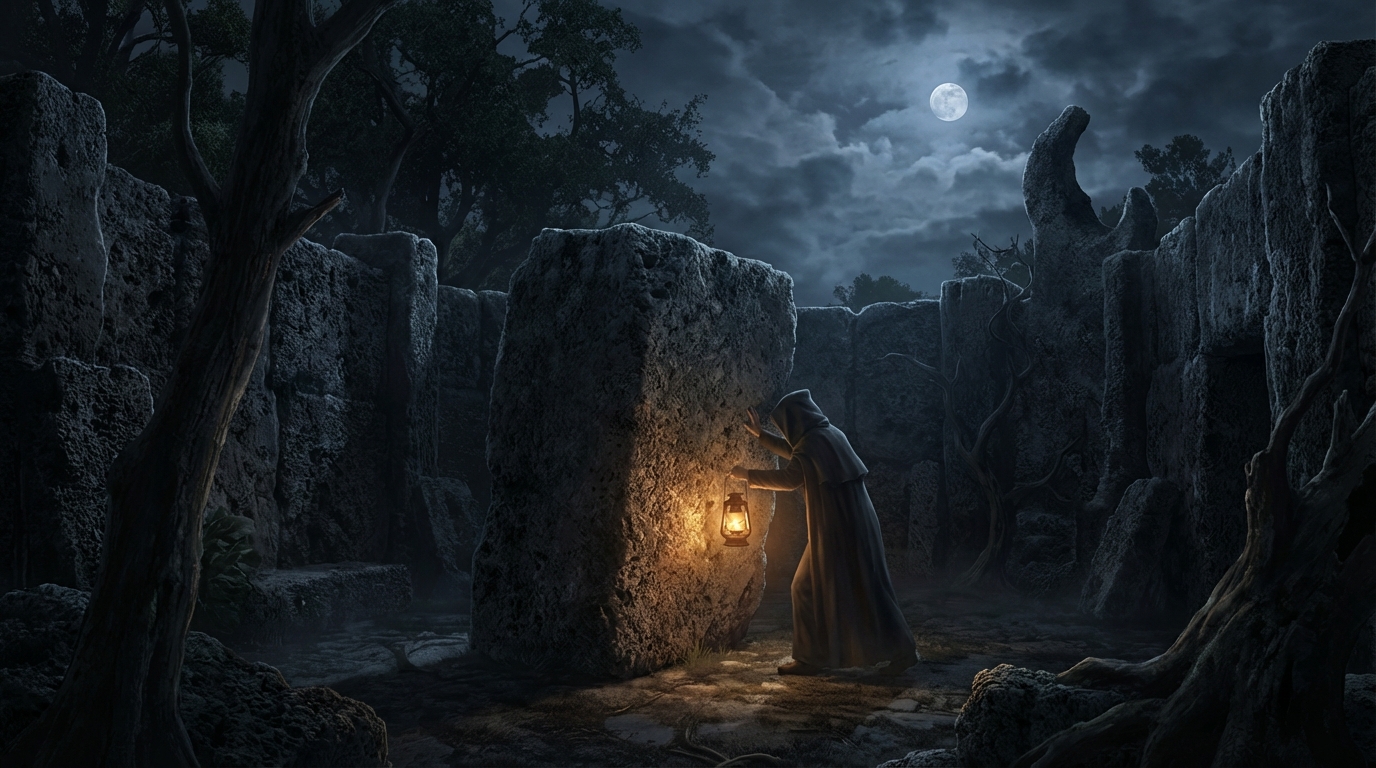
Coral Castle
"I have discovered the secrets of the pyramids" —said the 100-pound man who moved 1,100 tons of stone alone
The Builder
"I have discovered the secrets of the pyramids, and have found out how the Egyptians and the ancient builders in Peru, Yucatan, and Asia, with only primitive tools, raised and set in place blocks of stone weighing many tons."
— Edward Leedskalnin, Coral Castle promotional pamphlet, circa 1940sEdward Leedskalnin was a Latvian immigrant who stood 5 feet tall and weighed approximately 100 pounds. Between 1923 and 1951, working entirely alone and almost exclusively at night, he quarried, carved, moved, and assembled over 1,100 tons of oolitic limestone into a remarkable structure in Homestead, Florida, that he called "Rock Gate Park"—now known as Coral Castle.
Leedskalnin was obsessively private about his methods. He worked only at night and would stop immediately if anyone came to watch. When asked how he moved the massive stones, he would smile and say he understood the laws of leverage and had discovered the secrets of the ancient builders. He published several pamphlets on his theories of magnetism and "cosmic force," but none clearly explained his construction techniques.
The Feats
"The nine-ton gate was so perfectly balanced on its center of gravity that a child could push it open with one finger. When it finally stopped working in 1986, it took a 50-ton crane, six men, and an engineer to remove and rebalance it."
— Ray Stoner, The Enigma of Coral Castle, 1980The centerpiece of Coral Castle is a 9-ton revolving gate—a massive block of limestone that rotated on a single truck bearing with such perfect balance that it could be pushed open with one finger. When the bearing finally failed in 1986, engineers who came to repair it discovered that the bearing sat at the precise center of gravity of the irregularly shaped stone—a point that had been determined and drilled with remarkable accuracy.
Other features include a 30-ton block carved into a functional rocking chair, a 5,000-pound heart-shaped table, a sundial accurate to within two minutes, walls made of blocks weighing up to 15 tons each, and a 22-ton obelisk. In 1936, Leedskalnin moved the entire structure—every stone—from its original location in Florida City to its current site in Homestead, 10 miles north, using only a borrowed truck and homemade equipment. The truck driver who transported the stones reported that they were always already loaded on the truck when he arrived, and Leedskalnin always unloaded them alone.
The Mundane Explanation
"Leedskalnin's techniques, while ingenious, are consistent with known principles of leverage, counterbalance, and mechanical advantage. A single person can move very large stones with the right tools and enough time."
— Wally Wallington, retired construction worker, who demonstrated similar techniques on video, 2006In 2006, retired construction worker Wally Wallington filmed himself moving and raising multi-ton concrete blocks using only wooden levers, pivots, and counterweights—techniques consistent with what Leedskalnin could have used. Wallington demonstrated that a single person, using basic physics, can move blocks weighing over 10 tons. Photographs of Coral Castle show tripods, block-and-tackle systems, and lever arrangements that are consistent with these methods.
Leedskalnin also had something that most people underestimate: time. He worked on Coral Castle for 28 years. Twenty-eight years of patient, solitary labor, working through the cool Florida nights. He didn't need to move stones quickly. He needed to move them eventually. With unlimited time and the right leverage, a 100-pound man can move a 30-ton stone. It's physics, not magic.
The "mystery" of Coral Castle has been largely solved by practical demonstrations. Leedskalnin used leverage, counterweights, and ingenious mechanical arrangements to move stones that seem impossibly heavy for one man. The physics is sound. The methods are reproducible.
And yet something about Coral Castle resists the mundane explanation. Not the physics—the motivation. Why did a heartbroken Latvian immigrant spend 28 years of his life building a stone monument in the Florida swamp? Leedskalnin said he built it for his "Sweet Sixteen"—Agnes Scuffs, a woman who jilted him the day before their wedding in Latvia. He never saw her again. He poured his grief into limestone.
There is also the matter of his writings. Leedskalnin's pamphlets on magnetism, cosmic force, and "magnetic current" read like the work of a brilliant autodidact who discovered real principles but described them in his own eccentric vocabulary. Some of his observations about the behavior of magnets and electrical currents are genuinely insightful, buried in layers of unconventional terminology. Was he a crackpot or an unrecognized genius? The answer may be both.
Coral Castle's real lesson isn't about lost technology or ancient secrets. It's about what a single person can accomplish with absolute dedication, unlimited patience, and a broken heart. That might be more extraordinary than any mystery.
Sources & Further Reading
- Leedskalnin, Edward — Magnetic Current (self-published, 1945)
- Stoner, Ray — The Enigma of Coral Castle (1980)
- Wallington, Wally — "The Forgotten Technology" (demonstration videos, 2006)
- Coral Castle Museum — Historical archives, Homestead, Florida
- Irwin, Orval — Mr. Can't Is Dead! The Story of the Coral Castle (1996)