Ancient Precision
Drill cores, saw marks, and tool signatures that don't match any tool the ancient Egyptians are supposed to have had
The Drill Cores
"The spiral groove on the core indicates a feed rate of 0.100 inch per revolution in granite—a rate that would require enormous pressure and a very hard cutting surface. Copper and sand cannot account for this."
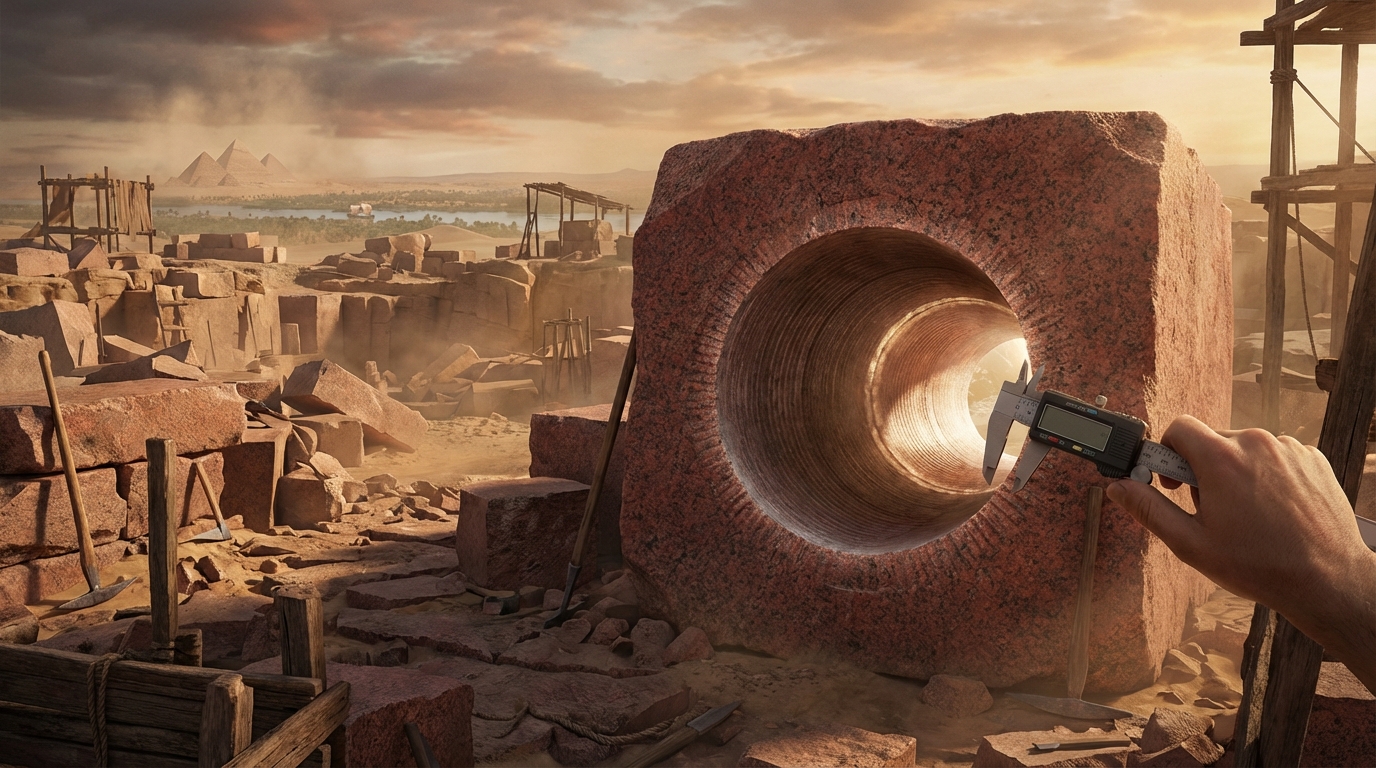
— Christopher Dunn, The Giza Power Plant: Technologies of Ancient Egypt, 1998In the rubble around the Giza plateau and other Egyptian sites, researchers have found granite drill cores—cylindrical plugs of stone removed during the drilling process. These cores, first documented extensively by W.M.F. Petrie in the 1880s, display spiral grooves running along their length. The grooves are continuous, like the threads of a screw, with a spacing (pitch) of approximately 0.050 inches (1.27 mm) per revolution.
This is significant because the groove pattern indicates that the drill was advancing into the granite at a consistent, measurable rate—cutting through one of the hardest common stones on a continuous helical path. Petrie himself was puzzled, writing that the drill must have been cutting into the granite "under enormous pressure." Christopher Dunn, a manufacturing engineer, calculated that the implied feed rate and pressure exceed what copper tube drills with quartz sand abrasive could achieve.
The Saw Marks
"On the north side of the coffer in the King's Chamber, there are clear marks left by a saw—the blade went too deep and was backed out, leaving a visible kerf. This coffer was cut from a single block of Aswan granite."
— W.M. Flinders Petrie, The Pyramids and Temples of Gizeh, 1883The granite coffer (sarcophagus) in the King's Chamber of the Great Pyramid shows clear saw marks on its exterior. Petrie documented these marks in detail: straight, parallel cuts consistent with a large, flat-bladed saw. On one side, the saw appears to have been backed out and repositioned, leaving telltale marks of the correction. The interior of the coffer was hollowed out by drilling—the drill marks are still visible.
The conventional explanation is that the Egyptians used copper saws and drills with quartz sand (or possibly corundum) as an abrasive. The copper blade or tube held the abrasive against the stone while the craftsman applied pressure and motion. This technique works—modern experimental archaeologists have demonstrated it. But the scale and precision of the marks on the King's Chamber coffer suggest a level of industrial capability that goes beyond what we typically attribute to Bronze Age craftsmen.
The Unfinished Obelisk
"The Unfinished Obelisk at Aswan, had it been completed, would have been the largest obelisk ever erected: 42 meters tall and weighing approximately 1,200 tonnes. The tool marks on its surface are our best window into Egyptian quarrying methods."
— Reginald Engelbach, The Aswan Obelisk, 1922In the granite quarries at Aswan lies the Unfinished Obelisk—a massive monolith abandoned mid-quarry when a crack appeared in the stone. At 42 meters in length, it would have been the tallest obelisk ever erected, weighing an estimated 1,200 tonnes. Its unfinished state is an archaeological gift: the tool marks are perfectly preserved, showing us exactly how the Egyptians quarried granite.
The marks show that workers used dolerite pounding balls—fist-sized spheres of a stone harder than granite—to chip away at the rock through sheer percussion. The channels around the obelisk are studded with these ball marks. This method is well-documented and undeniably effective. But it's also extremely slow and labor-intensive. Estimates suggest that hundreds of workers pounding continuously could remove a few centimeters of granite per day.
Ancient precision is not a single mystery but a pattern of anomalies that, taken together, suggest the ancient Egyptians had manufacturing capabilities beyond what their known toolbox should allow. The drill cores with their spiral grooves. The saw marks on granite coffers. The flat surfaces finished to optical quality. The drill holes in the hardest diorite vases, with walls so thin they're translucent.
The mainstream explanation—copper tools plus abrasive sand, with extraordinary patience and skill—accounts for most of the evidence. Experimental archaeologists have drilled granite with copper tubes and sand. It works. Slowly. With tremendous effort. But it works.
The dissonance lies in the details. The spiral grooves on the drill cores suggest continuous cutting, not the intermittent scraping of sand grains under a copper tube. The feed rate implied by the groove spacing (0.050 inches per revolution) requires downward pressure that would buckle a copper tube. The saw marks on the King's Chamber coffer are straighter and more uniform than experimental copper-and-sand saws typically produce.
Were the Egyptians simply better at copper-and-sand machining than our experiments suggest? Did they use harder materials we haven't identified? Did they discover techniques that we haven't replicated? The tools themselves haven't survived—copper was too valuable to discard. We're reading the story from the marks they left in stone, and those marks tell a story that doesn't quite match our assumptions.
The Unfinished Obelisk shows us one part of the puzzle: quarrying by percussion. The drill cores and saw marks show us another: precision machining that pushes the boundaries of what we think was possible. Somewhere between the brute force of dolerite pounders and the surgical precision of those spiral grooves lies a gap in our understanding. That gap is the mystery.
Sources & Further Reading
- Petrie, W.M. Flinders — The Pyramids and Temples of Gizeh (1883)
- Dunn, Christopher — The Giza Power Plant: Technologies of Ancient Egypt (1998)
- Dunn, Christopher — Lost Technologies of Ancient Egypt (2010)
- Stocks, Denys A. — Experiments in Egyptian Archaeology: Stoneworking Technology in Ancient Egypt (2003)
- Engelbach, Reginald — The Aswan Obelisk (1922)
- Arnold, Dieter — Building in Egypt: Pharaonic Stone Masonry (1991)