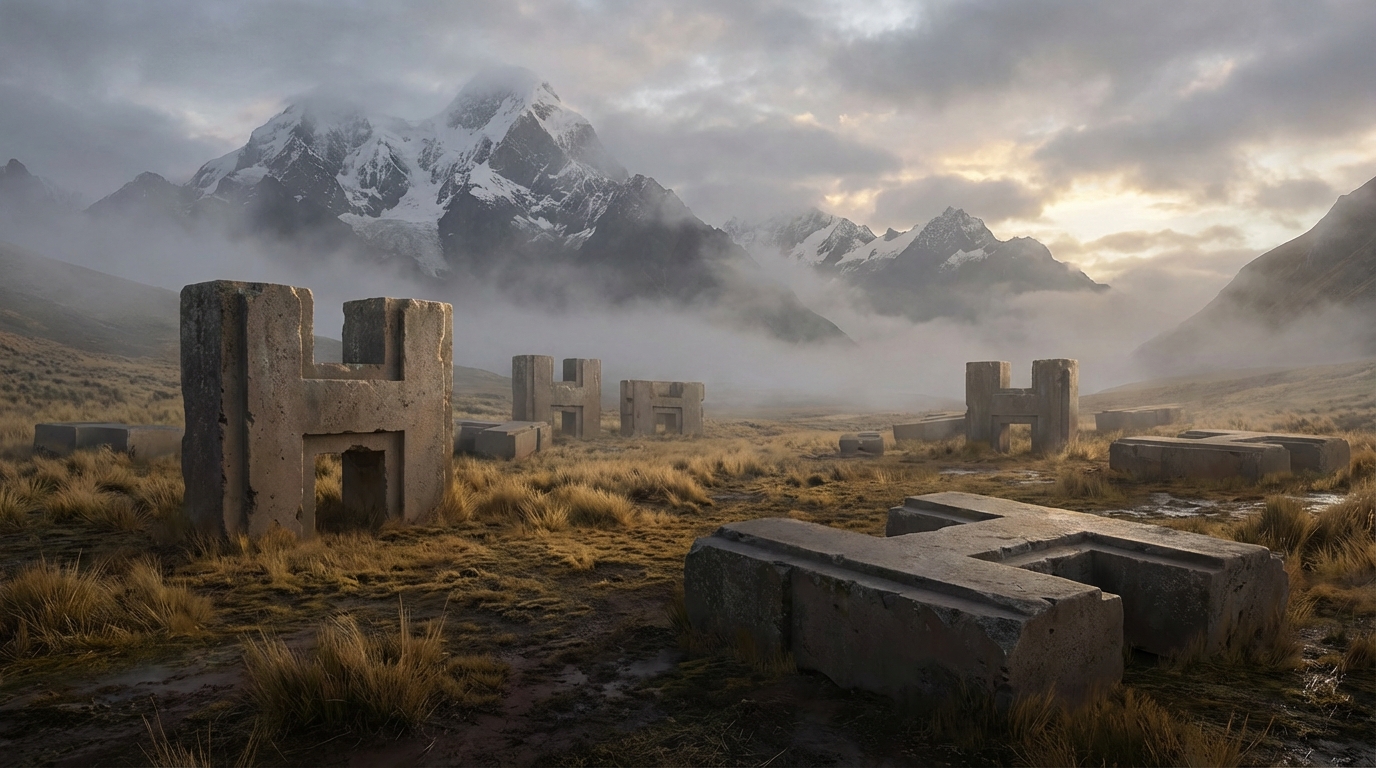
Puma Punku
Machine-flat surfaces and identical drill holes in one of the hardest stones on Earth—carved with no metal tools
The H-Blocks
"The precision of the stone cutting at Puma Punku is unlike anything else in the pre-Columbian world. The H-shaped blocks interlock with a uniformity that suggests standardized, repeatable manufacturing—something we don't associate with ancient stonework."
— Alexei Vranich, UCLA archaeologist, fieldwork at Tiwanaku, 2009At an altitude of 3,800 meters on the Bolivian Altiplano, near the shores of Lake Titicaca, lie the ruins of Puma Punku—part of the ancient city of Tiwanaku. What remains is a scattered field of precisely cut stone blocks, many carved from andesite, one of the hardest stones used in ancient construction (6 on the Mohs hardness scale, comparable to steel).
The signature elements are the H-blocks: large, interlocking stone modules cut with flat surfaces, right angles, and identical recesses that fit together like pieces of a massive stone puzzle. The blocks feature drill holes approximately 6 millimeters in diameter, spaced at uniform intervals. The flat surfaces are so smooth that when two blocks are placed together, they create a near-airtight seal.
The Precision Problem
"I've been cutting stone for thirty years. I could not replicate these cuts with hand tools. The right angles, the uniform depth of the recesses, the consistent drill hole spacing—this looks like machine work."
— Master stonemason Roger Hopkins, on-site assessment at Puma Punku (NOVA documentary, 1997)The Tiwanaku civilization that built Puma Punku (roughly 536–600 AD, though dating is debated) had no iron or steel tools, no written language, and no known wheel or pulley system. Their toolbox, as far as we can determine, consisted of stone hammers, copper chisels, and abrasive sand. Copper is softer than andesite. This is like trying to carve granite with a butter knife.
Yet the results speak for themselves. Ninety-degree inside corners. Uniform recesses cut to identical depths across multiple blocks. Drill holes that maintain their diameter and spacing with a consistency that suggests guides or templates. Multiple professional stonemasons who have examined the site have stated they could not replicate the work with hand tools—not because it's theoretically impossible, but because the precision required would take so long with primitive tools that the labor investment becomes incomprehensible.
The Modular Mystery
"Puma Punku was essentially a pre-fabricated building. The stone blocks were cut to standard dimensions and designed to interlock without mortar. This is modular construction—a concept we think of as modern."
— Jean-Pierre Protzen, UC Berkeley, Inca Architecture and Construction at Ollantaytambo, 1993What makes Puma Punku extraordinary isn't just the precision—it's the concept. The H-blocks and their associated components were designed as a modular construction system. Identical blocks could be assembled in multiple configurations, connected by metal clamps (copper-arsenic-nickel alloy) poured into I-shaped grooves. This is, in essence, a prefabricated building system—standardized components, interchangeable parts, metal fasteners.
We typically associate modular, standardized construction with industrialization. The concept of interchangeable parts is credited to Eli Whitney in the late 18th century. Yet here it is, implemented in stone at 3,800 meters altitude on the Bolivian Altiplano, by a culture that left no written records explaining how or why.
Puma Punku is one of the most frustrating archaeological sites on Earth, because the ruins are too scattered and too damaged for us to reconstruct what the original structure looked like. Centuries of looting, earthquake damage, and use as a quarry by colonial-era builders have reduced the site to a jumble of precision-cut fragments. We have the pieces of the puzzle but no picture on the box.
Jean-Pierre Protzen of UC Berkeley has demonstrated that Tiwanaku stone-working techniques can achieve flat surfaces and right angles using pounding stones and abrasive sand. The techniques are laborious but effective. This proves the work was possible with available tools. What it doesn't explain is the scale and consistency—producing hundreds of identical modular components to such tight tolerances that they interlock without mortar requires either extraordinary quality control or tools we haven't identified.
The metal clamps deserve special attention. Chemical analysis of the I-shaped metal clamps reveals a copper-arsenic-nickel alloy that was poured molten into the stone grooves. This means the Tiwanaku people had portable smelting capabilities on-site and understood metallurgy well enough to create specific alloys for specific structural purposes. They were more technologically sophisticated than we typically give them credit for.
Puma Punku doesn't require aliens or lost super-civilizations to explain. It requires us to accept that a pre-literate, pre-iron Andean society achieved levels of engineering precision and conceptual sophistication that challenge our assumptions about what "primitive" cultures could accomplish. And that might be the most unsettling answer of all.
Sources & Further Reading
- Protzen, Jean-Pierre & Nair, Stella — The Stones of Tiahuanaco (2013)
- Vranich, Alexei — "The Construction and Reconstruction of Ritual Space at Tiwanaku," Journal of Field Archaeology (2006)
- Kolata, Alan — The Tiwanaku: Portrait of an Andean Civilization (1993)
- Protzen, Jean-Pierre — Inca Architecture and Construction at Ollantaytambo (1993)
- Ponce Sangines, Carlos — Tiwanaku: Espacio, Tiempo y Cultura (1972)