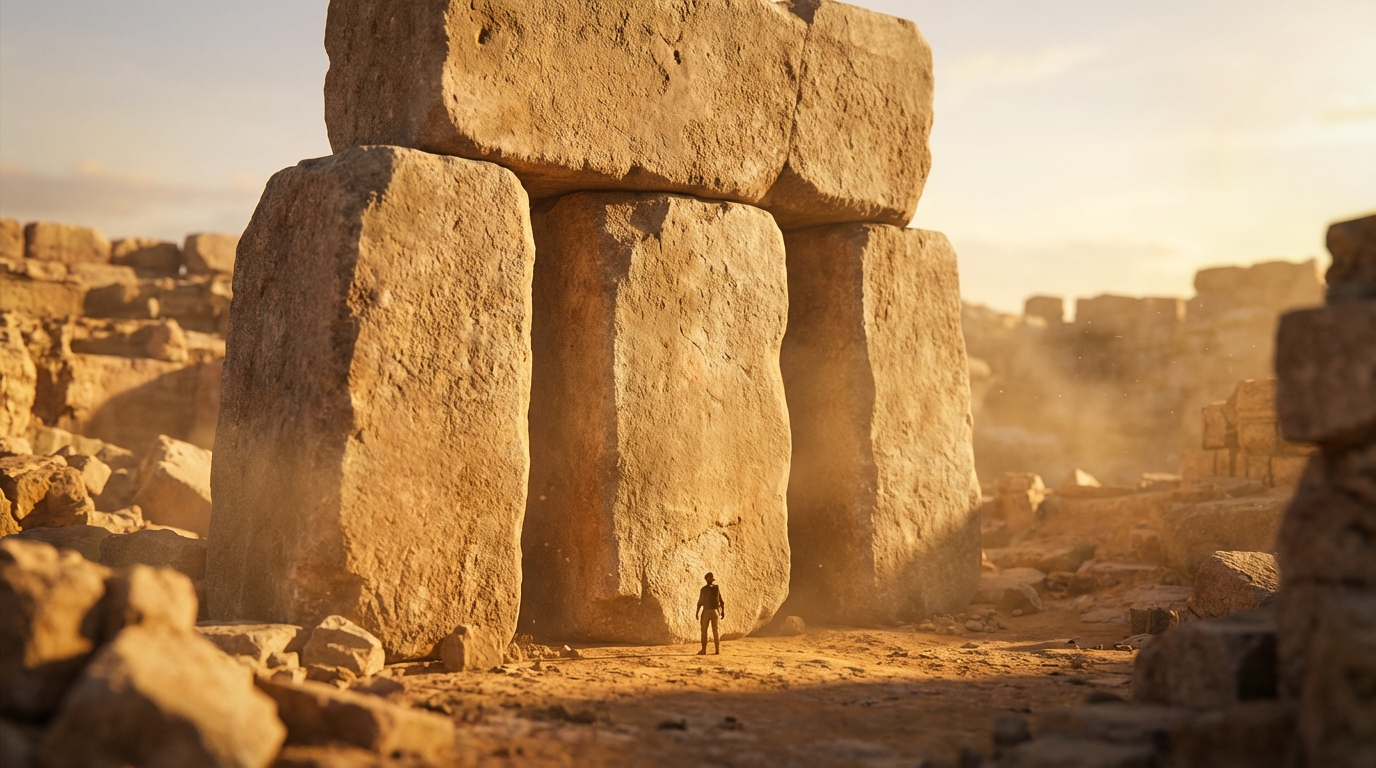
Baalbek
The largest cut stones in human history—lifted, transported, and placed with joints so tight you can't slide paper between them
The Trilithon
"The three stones of the Trilithon are, to this day, the largest cut and moved stones in the world. Each weighs between 750 and 800 tonnes. They sit atop a podium wall, raised approximately 7 meters above ground level."
— Daniel Lohmann, German Archaeological Institute, "Giant Strides Towards Monumentality," 2010At Baalbek in modern-day Lebanon lies the Temple of Jupiter, one of the most impressive Roman temple complexes ever built. But beneath the Roman construction sits something far older and far more puzzling: the Trilithon. Three massive limestone blocks, each approximately 19 meters long, 4.3 meters high, and 3.6 meters deep, weighing between 750 and 800 tonnes each. They are fitted together horizontally in a retaining wall, raised roughly 7 meters above ground level, with joints so precise that a razor blade cannot be inserted between them.
No mortar was used. No cement. Just stone against stone, fitted with a precision that modern construction engineers describe as extraordinary. Each block weighs roughly the same as 200 full-grown elephants. And someone lifted them into place.
The Stone of the Pregnant Woman—and the Forgotten Stone
"In 2014, a German-Lebanese archaeological team excavated a megalith at the Baalbek quarry measuring 19.6 meters in length and weighing an estimated 1,650 tonnes—the largest known ancient worked stone in the world."
— German Archaeological Institute, Baalbek excavation report, 2014A few hundred meters from the temple complex lies the ancient quarry. Here sits the "Stone of the Pregnant Woman" (Hajar el-Hibla), a partially quarried megalith weighing approximately 1,000 tonnes. It was clearly intended for the temple complex but was never moved. For centuries, it was considered the largest worked stone from antiquity.
Then, in 2014, a German-Lebanese team excavated beneath it and found something even larger: a stone measuring 19.6 meters long, 6 meters wide, and 5.5 meters tall, with an estimated weight of 1,650 tonnes. They nicknamed it the "Forgotten Stone." It too was partially quarried and abandoned in place. The builders of Baalbek were working with stones that exceed the lifting capacity of our largest modern cranes.
The Engineering Problem
"We have no satisfactory engineering explanation for how the Trilithon blocks were transported from the quarry and raised into position. Proposed methods involving ramps, rollers, and human labor require logistics that strain credibility."
— Jean-Pierre Adam, Roman Building: Materials and Techniques, 1994The quarry is approximately 800 meters from the temple platform. The route includes a slight uphill grade. The blocks needed to be transported horizontally, then lifted 7 meters vertically and placed with sub-millimeter precision. Roman engineering was sophisticated—they built aqueducts, roads, and the Colosseum—but no Roman text describes moving stones of this magnitude. The largest stones typically used in Roman construction weigh 50–100 tonnes. The Trilithon stones are eight to ten times heavier.
Various theories have been proposed: timber rollers on prepared roads, massive sledges with thousands of laborers, sophisticated lever-and-fulcrum systems. All are theoretically possible. None have been demonstrated at this scale. And none explain the precision of the final placement—how do you align 800-tonne blocks to sub-millimeter tolerances using ropes, rollers, and human muscle?
Baalbek's deepest mystery isn't the Roman temple—it's the platform the Romans built upon. Archaeological evidence suggests the massive foundation predates the Roman construction, possibly by centuries. The Romans were famous for building on existing foundations, and the Trilithon's construction style differs from the Roman layers above it. Who built the original platform? When? And why did they choose to work with stones of such staggering size when smaller blocks would have been far easier?
Local legends attribute the platform to the Jinn—supernatural beings who served King Solomon. Other traditions claim it was built before the Great Flood. These are myths, but myths often preserve cultural memory of real events. Something happened at Baalbek that was so impressive, so beyond the capabilities of the people who witnessed it, that it became the stuff of legend.
The conventional explanation—Roman engineering, applied at an unprecedented scale—may well be correct. The Romans were capable of extraordinary feats. But Baalbek asks us to accept that they exceeded their documented capabilities by an order of magnitude at this single site, for reasons they never recorded, using methods they never described. It's not impossible. But it should give us pause.
The Forgotten Stone, still sleeping in its quarry after millennia, is perhaps the most eloquent testimony. Someone believed they could move a 1,650-tonne block of limestone. They started quarrying it with that intention. Whether they succeeded at that scale or decided it was too ambitious, the ambition itself is breathtaking.
Sources & Further Reading
- Lohmann, Daniel — "Giant Strides Towards Monumentality," Baalbek/Heliopolis: Results of Archaeological and Architectural Research (2010)
- Adam, Jean-Pierre — Roman Building: Materials and Techniques (1994)
- German Archaeological Institute — Baalbek excavation reports (2014–2015)
- Ruprechtsberger, Erwin M. — Vom Steinbruch zum Jupitertempel von Heliopolis/Baalbek (1999)
- Alouf, Michel M. — History of Baalbek (1890, reprinted 1998)