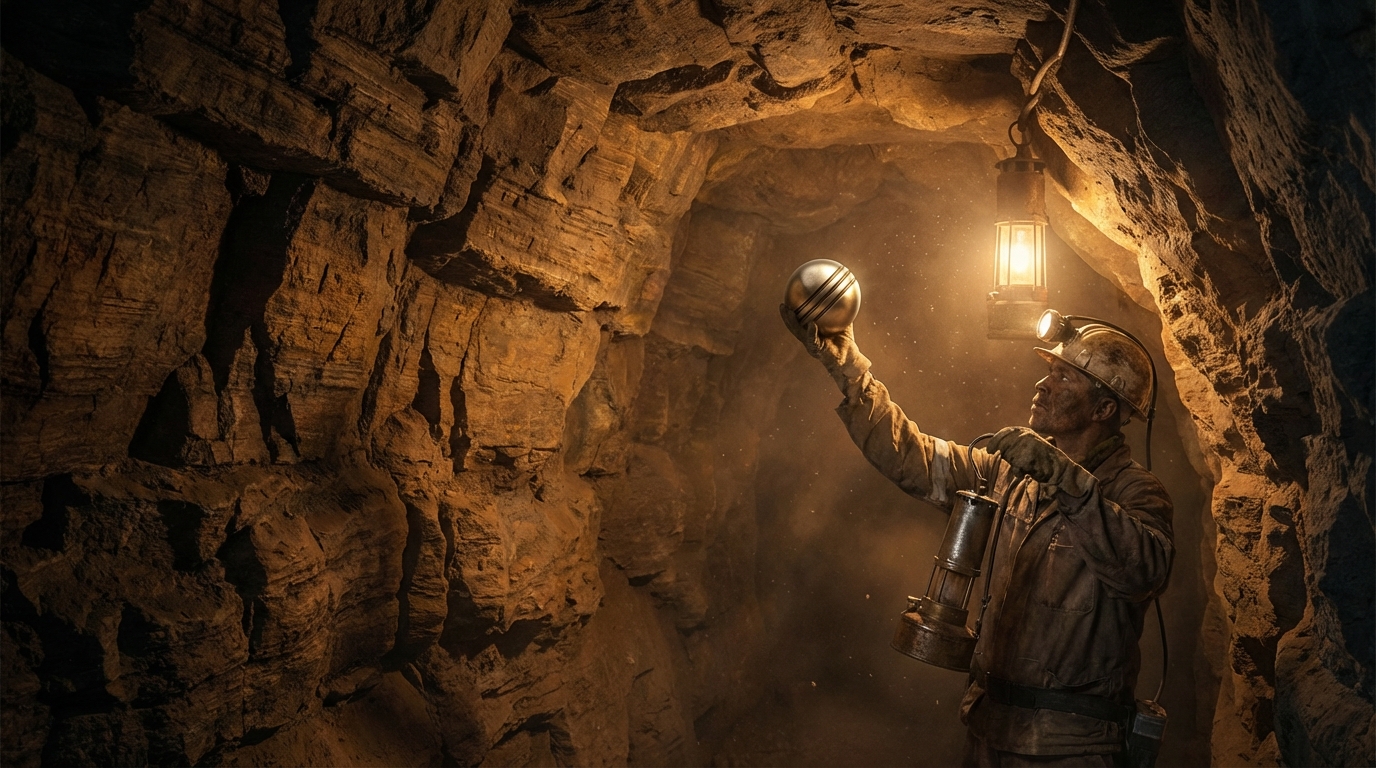
The Klerksdorp Spheres
Grooved spheres from 3-billion-year-old rock—when Earth's most complex life was single-celled
The Objects
"The spheres are found in pyrophyllite deposits dated to the Precambrian era, approximately 2.8 to 3 billion years old. They range from 0.5 to 10 centimeters in diameter, and many display one to three parallel grooves around their equators."
— Roelf Marx, curator, Klerksdorp Museum, South Africa, 1984For decades, miners in the Ottosdal region of South Africa's North West Province have been finding small, spherical or disc-shaped objects in pyrophyllite deposits that are approximately 2.8 billion years old. The objects range from about half a centimeter to ten centimeters in diameter. Some are composed of a bluish metal with white flecks; others are hollow and filled with a spongy white substance. Many display one, two, or three parallel grooves running precisely around their equators.
Roelf Marx, then curator of the Klerksdorp Museum, collected hundreds of specimens over the years. He noted that the spheres appeared to be remarkably uniform in shape—some nearly perfectly spherical—and that the grooves were too regular to be random geological formations. He famously claimed that one sphere displayed such precise balance that it exceeded the tolerances achievable with modern manufacturing equipment, though this claim has been disputed.
The Geological Explanation
"The objects are natural concretions formed by the precipitation of volcanic sediments. The grooves are formed by fine-grained laminae within theite matrix."
— Heinrich, "The Mystery of the Grooved Spheres," The Skeptical Inquirer, 2007Geologist Paul V. Heinrich conducted a thorough analysis of the Klerksdorp Spheres and concluded they are natural concretions—mineral formations that grew layer by layer within volcanic ash deposits. Concretions often form spherical shapes due to the physics of mineral precipitation, and the grooves correspond to boundaries between different mineral layers in the surrounding sediment. Similar concretions (called Moqui marbles and Kansas pop rocks) are found worldwide.
The spheres are composed primarily of hematite (iron oxide) and wollastonite, both minerals commonly found in metamorphosed volcanic sediments. Their formation is entirely consistent with known geological processes—no manufacturing required.
The Lingering Questions
"I've been a geologist for forty years and I've never seen concretions this regular, this spherical, with grooves this precise. Natural concretions are typically lumpy, irregular. These are different."
— Attributed to Professor Andries Bisschoff, University of Potchefstroom (informal communication, disputed)The natural concretion explanation is compelling and likely correct for most of the Klerksdorp Spheres. But a few of the specimens are genuinely unusual. The regularity of certain spheres—their near-perfect roundness and the precision of their equatorial grooves—exceeds what is typically seen in natural concretions. Most natural concretions are oblate, lumpy, or irregular. A subset of the Klerksdorp Spheres are remarkably geometric.
The age of the deposits is also relevant to the mystery's appeal, if not its solution. Three billion years ago, the only life on Earth was single-celled microorganisms. If these spheres were manufactured—and to be clear, the scientific consensus is that they were not—it would imply the existence of an intelligent civilization so ancient that it predates complex life itself. The sheer impossibility of this timeline is part of what makes the Klerksdorp Spheres so captivating to alternative researchers.
The Klerksdorp Spheres occupy an unusual place in the catalogue of mysterious objects. Unlike the Baghdad Battery or the Antikythera Mechanism, there is no plausible scenario in which they are manufactured artifacts. Three billion years ago, Earth was a world of bacteria and archaea. There were no hands to shape metal, no minds to conceive of grooved spheres.
What the spheres actually demonstrate is something perhaps equally fascinating: the ability of natural geological processes to create objects that look manufactured. Nature is a remarkably creative sculptor. Given billions of years, the right mineral chemistry, and the steady pressure of geological forces, it can produce spheres, grooves, and symmetries that fool the human eye into seeing intention where there is only physics.
This is a useful lesson. Our brains are pattern-recognition machines, evolved to detect the fingerprints of intentional design. When we see symmetry, regularity, and geometric precision, we instinctively think "someone made this." The Klerksdorp Spheres remind us that this instinct, while often correct, can also mislead. Sometimes a sphere is just a sphere—a beautiful accident of mineralogy and time.
And yet. Hold one in your hand. Feel its weight, its smoothness, the precise groove running around its middle. Tell your instincts it's just a concretion. See if they believe you.
Sources & Further Reading
- Heinrich, Paul V. — "The Mystery of the Grooved Spheres," The Skeptical Inquirer (2007) — see also Klerksdorp sphere (Wikipedia)
- Cairncross, Bruce — "The Ottosdal Spheres," Geological Society of South Africa (2001)
- Marx, Roelf — Klerksdorp Museum collections and commentary (1984)
- Cremo, Michael & Thompson, Richard — Forbidden Archaeology (1993)
- Bisschoff, Andries — Mineralogical analyses, University of Potchefstroom (1969)