The London Hammer
An iron hammer embedded in rock—a genuine geological puzzle wrapped in a creationist controversy
The Discovery
"While walking along Red Creek near London, Texas, the Hahns noticed a piece of loose rock with a piece of wood protruding from it. When they cracked the rock open at home, they found a complete iron hammerhead."
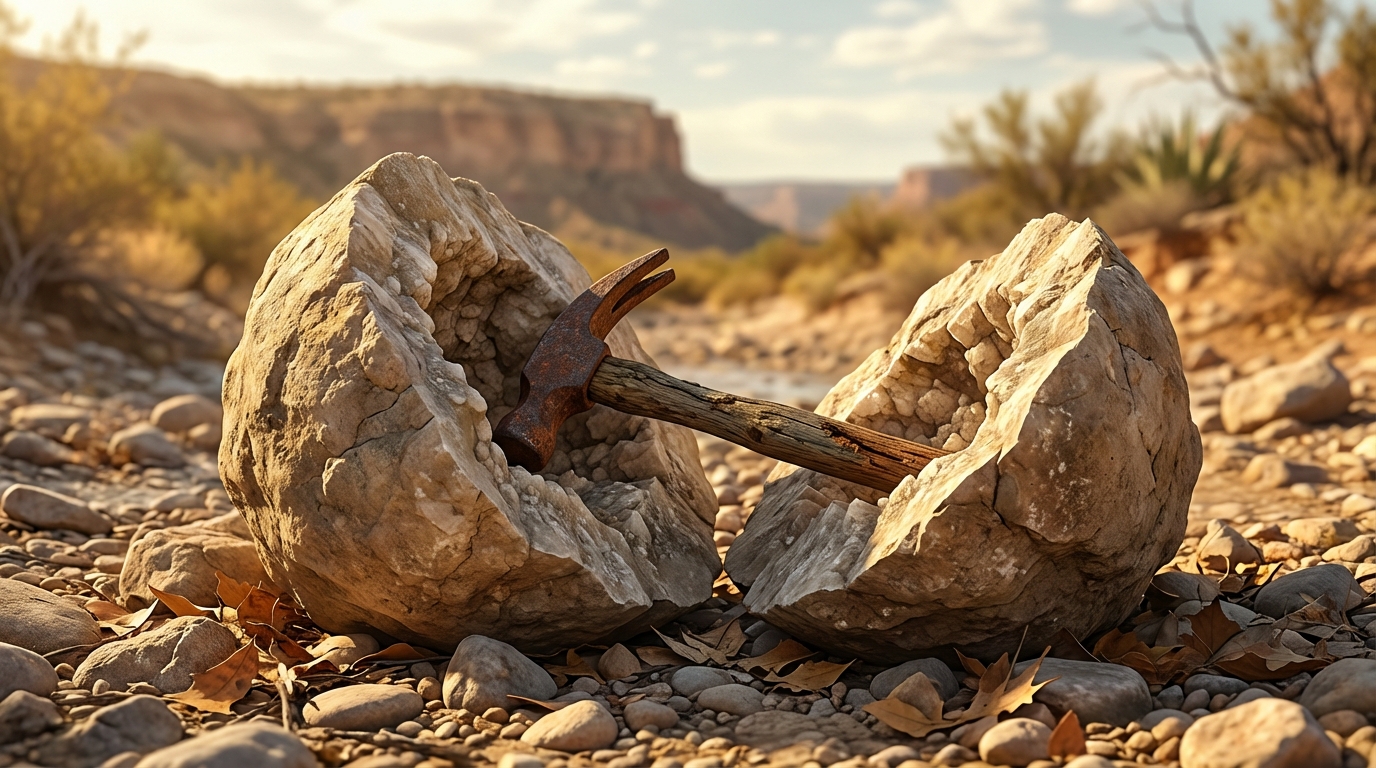
— Account of discovery by Max Hahn, 1936 (as reported by Carl Baugh)In June 1936, Max Hahn and his wife Emma were walking along Red Creek near the small town of London, Texas, when they spotted a curious rock with a piece of wood sticking out of it. They took it home. When Max cracked the rock concretion open, he found an iron hammerhead, complete with a portion of its wooden handle, entirely encased within the stone.
The hammer sat in the Hahn family's possession for decades until it was acquired in 1983 by Carl Baugh, a creationist who founded the Creation Evidence Museum in nearby Glen Rose, Texas. Baugh claimed the rock surrounding the hammer was Ordovician limestone—approximately 400 million years old—proving that human-made tools existed hundreds of millions of years before humans supposedly evolved.
The Geology
"Calcium carbonate concretions can form around modern objects in relatively short periods—years to decades, not millions of years. The age of the concretion does not equal the age of the object inside it."
— John Cole, "If I Had a Hammer," Creation/Evolution, 1985The geological explanation is straightforward, though less dramatic than the creationist claim. The rock encasing the hammer is not bedrock limestone. It is a concretion—a mass of calcium carbonate that precipitated around the hammer from mineral-laden water. Concretions can form around any object in the right chemical conditions, and they can form remarkably quickly. There are well-documented cases of concretions forming around modern objects (fencing wire, soda bottles, World War II artifacts) within decades.
The hammer itself is consistent with 19th-century American mining tools. Its design, metallurgy, and wooden handle match hammers commonly used by miners in the Texas region during the 1800s. It was likely dropped or discarded near the creek, where mineral-rich water gradually deposited a rock-like casing around it.
The Metallurgy Question
"Analysis of the hammerhead indicated it was composed of 96.6% iron, 2.6% chlorine, and 0.74% sulfur—an unusual composition that does not match any known modern or historical alloy."
— Metallurgical analysis commissioned by Carl Baugh (lab and date disputed)The one genuinely intriguing aspect of the London Hammer is its reported metallurgical composition. Analysis commissioned by Baugh claimed the iron contained no carbon (unusual for any iron tool), and included chlorine in a proportion not seen in known iron alloys. The hammerhead also reportedly shows no signs of rust on the exposed surfaces, despite being made of iron in a humid environment.
However, these claims are difficult to verify. The analysis was commissioned by Baugh himself, and the original laboratory and methodology have been questioned. Independent metallurgical testing has not been permitted on the artifact. Without peer-reviewed analysis by independent researchers, the unusual composition claims remain unconfirmed.
The London Hammer is a case study in how a mundane explanation and an extraordinary claim can coexist around the same object. The most likely explanation—a 19th-century mining hammer encased in a rapidly formed concretion—is well-supported by geological science and requires no extraordinary assumptions.
But the London Hammer also illustrates a real and fascinating geological phenomenon: the speed at which natural processes can make recent objects look ancient. Concretion formation, mineral replacement, and chemical alteration can transform a modern object into something that appears to be embedded in ancient rock in a matter of years. This has genuine implications for how we interpret geological finds—context and formation processes matter as much as the apparent age of surrounding rock.
The hammer currently resides in the Creation Evidence Museum in Glen Rose, Texas, where it is displayed alongside other artifacts of disputed provenance. It has never been submitted for independent, peer-reviewed geological or metallurgical analysis—a fact that speaks volumes. If the hammer truly were evidence of pre-human technology, its owners would have every incentive to prove it. Their reluctance to allow independent testing suggests they know what the results would show.
Still, the London Hammer reminds us that the boundary between "ancient" and "modern" in geological terms is not always as clear as we assume. Nature is a skilled forger.
Sources & Further Reading
- Cole, John R. — "If I Had a Hammer," Creation/Evolution (1985)
- Kuban, Glen J. — "The London Hammer: An Alleged Out-of-Place Artifact" (1997)
- Baugh, Carl — Claims and counter-claims, Creation Evidence Museum (1983–present)
- Isaak, Mark — "The London Artifact," TalkOrigins Archive (2006)
- Whitcomb, John C. & Morris, Henry M. — The Genesis Flood (1961)