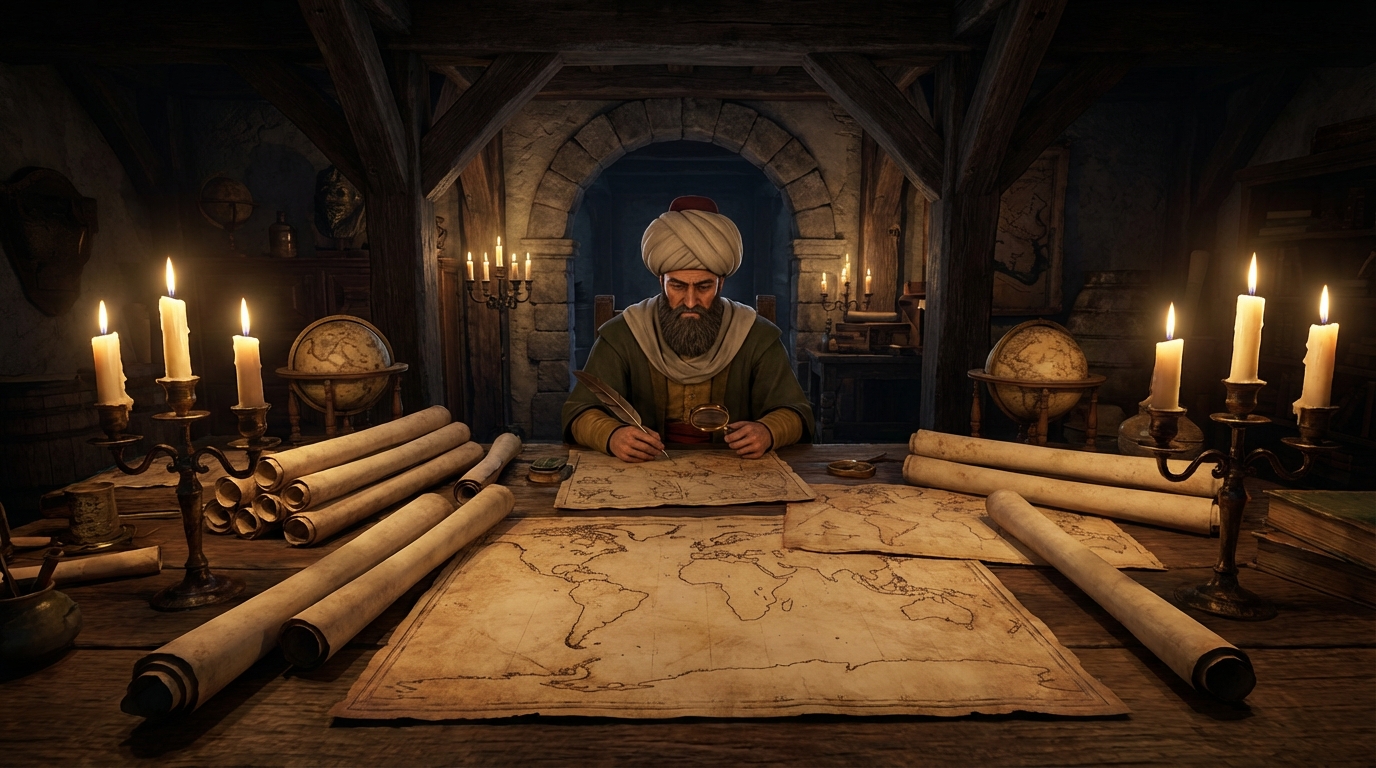
The Piri Reis Map
A 1513 Ottoman map compiled from source charts that shouldn't have existed—showing lands not yet "discovered"
The Map
"In drawing this map, I made use of about twenty charts and mappae mundi—charts drawn in the time of Alexander the Great, which show the inhabited quarter of the world."
— Piri Reis, marginal notes on the map, 1513In 1929, a fragment of a gazelle-skin parchment was discovered during the renovation of the Topkapi Palace in Istanbul. It was a nautical chart drawn in 1513 by Hadji Ahmed Muhiddin Piri, an Ottoman admiral and cartographer known as Piri Reis. The surviving fragment shows the western coast of Africa, the eastern coast of South America, and—most controversially—what appears to be a landmass to the south that some researchers have identified as the coast of Antarctica.
In his own marginal notes, Piri Reis states he compiled the map from approximately twenty source charts, including maps dating to the time of Alexander the Great (4th century BC), Portuguese charts of the Indian Ocean and China seas, maps drawn by Columbus, and four charts created by "Indian" (possibly indigenous South American) sources. Most of these source maps are now lost.
The Antarctica Question
"The lower portion of the map portrays the Princess Martha Coast of Queen Maud Land, Antarctica, and the Palmer Peninsula. The agreement of the Piri Reis map with the seismic profile of this area is remarkable."
— Charles Hapgood, Maps of the Ancient Sea Kings, 1966In 1960, Charles Hapgood, a professor of history at Keene State College in New Hampshire, made a provocative claim that would make the Piri Reis map famous. Hapgood argued that the southern portion of the map depicted the coastline of Antarctica—not as it looks today, buried under miles of ice, but as it would appear ice-free. He further claimed that when the map was re-projected using a different center point, the coastlines matched the sub-glacial topography of Queen Maud Land with startling accuracy.
If Hapgood was right, it meant that someone—some ancient, unknown civilization—had surveyed Antarctica before it was covered by ice, which last occurred roughly 6,000 years ago at minimum, and possibly much longer. Hapgood's thesis was endorsed in writing by Albert Einstein, who found the argument "electrifying" and wrote the foreword to Hapgood's book on earth crust displacement theory.
The Skeptical View
"The 'Antarctica' on the Piri Reis map is most likely a speculative extension of the South American coastline, a common cartographic convention of the period."
— Gregory McIntosh, The Piri Reis Map of 1513, 2000Modern cartographic analysis has challenged Hapgood's interpretation. Gregory McIntosh and other cartographic historians argue that the southern landmass is simply Patagonia, rotated and distorted to fit the available parchment—a common practice in portolan chart-making. The coastline details match South America far better than they match Antarctica's sub-glacial profile when standard cartographic analysis is applied.
Furthermore, the accuracy of the map, while impressive, is not supernatural. Piri Reis was an experienced admiral who had access to the best nautical charts of his era, including Portuguese maps based on actual voyages to Brazil. The coastline accuracy is comparable to other 16th-century portolan charts.
The most interesting aspect of the Piri Reis map isn't the Antarctica debate—it's the source maps. Piri Reis claims to have used charts dating to antiquity, including the Alexandrian period. If true, these source maps represent a cartographic tradition stretching back over 1,800 years before the map was drawn. Where did they come from? What surveying expeditions produced them? And how were they preserved and transmitted across so many centuries?
We know that the Library of Alexandria housed an enormous collection of geographical and navigational documents. We know that ancient Phoenician, Greek, and possibly Carthaginian navigators sailed far beyond the Mediterranean. The Greek mathematician Eratosthenes calculated the circumference of the Earth to within 2% accuracy in the 3rd century BC. Ancient cartographic knowledge was more extensive than we typically assume.
The Piri Reis map may not show Antarctica. But it does show us that the flow of geographical knowledge in the ancient and medieval world was far richer and more complex than our surviving sources suggest. Somewhere in the chain of transmission between Alexander's cartographers and a 16th-century Ottoman admiral, there were maps, surveys, and voyages that we know nothing about. Those lost source charts are the real mystery.
Sources & Further Reading
- Hapgood, Charles — Maps of the Ancient Sea Kings (1966)
- McIntosh, Gregory — The Piri Reis Map of 1513 (2000)
- Piri Reis — Kitab-i Bahriye (Book of Navigation), 1521/1526
- Soucek, Svat — Piri Reis and Turkish Mapmaking After Columbus (1992)
- Afetinan, A. — Life and Works of Piri Reis, Turkish Historical Society (1975) — see also Piri Reis map (Wikipedia)