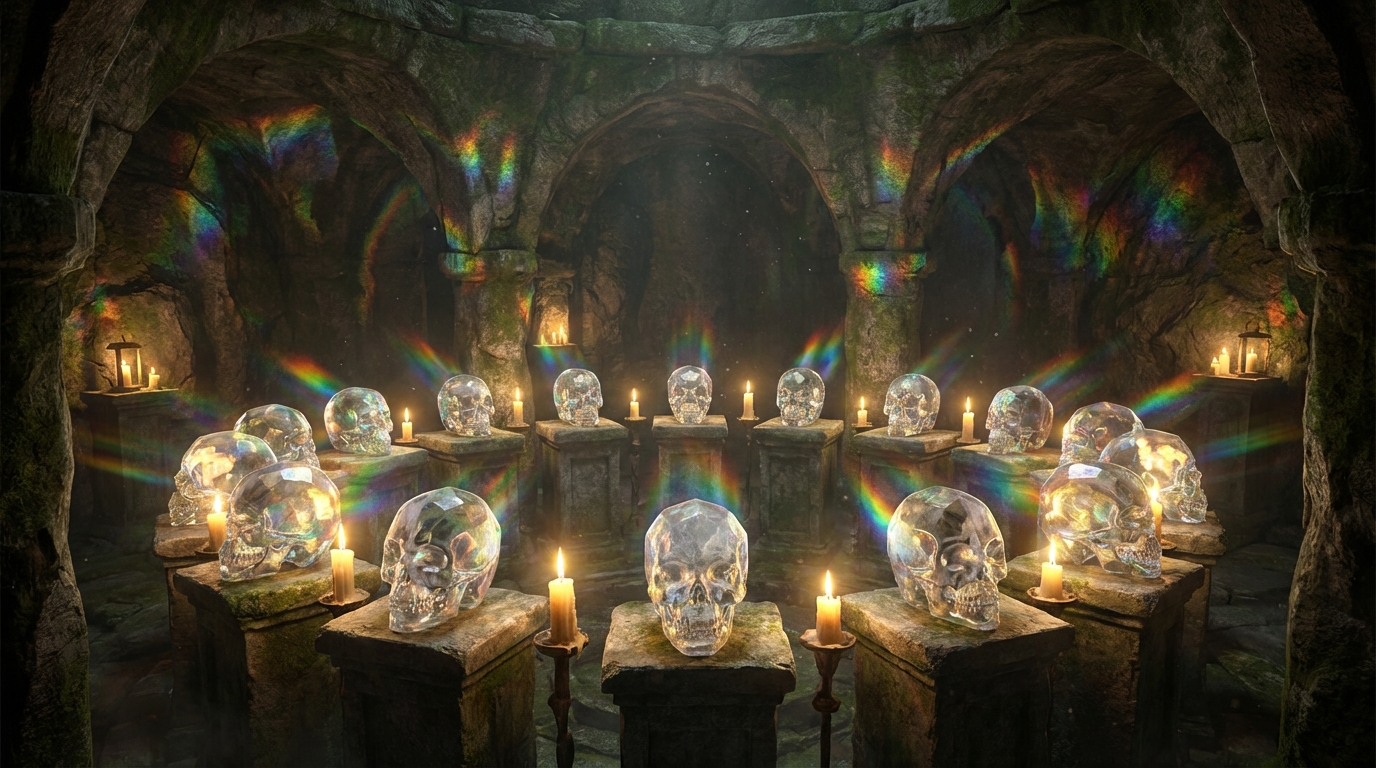
The Crystal Skulls
Science debunked them. The legend didn't care.
The Legend
"There exist thirteen crystal skulls of the same size, scattered across the earth. When the time comes for humanity's greatest trial, all thirteen must be reunited—or civilization will end."
— Attributed to various Central American indigenous traditions (provenance disputed)The legend of the crystal skulls is one of the most persistent in the world of mysterious artifacts. The story goes that thirteen life-sized human skulls, carved from single pieces of clear quartz crystal, were created by ancient Mesoamerican civilizations—the Maya, the Aztecs, or possibly a civilization predating both. Each skull was said to possess supernatural properties: healing powers, the ability to induce visions, or the capacity to store and transmit information like a crystalline hard drive.
The most famous is the Mitchell-Hedges skull, allegedly discovered in 1924 by Anna Mitchell-Hedges in a ruined temple at Lubaantun, Belize. It is an anatomically accurate, life-sized human skull carved from a single block of clear quartz, with a detachable jawbone. It weighs approximately 5 kilograms and displays remarkable optical properties—light entering the cranium is channeled through the eye sockets, creating an eerie glowing effect.
The Science
"Scanning electron microscopy reveals tool marks consistent with modern lapidary equipment—specifically, rotary wheel cutting tools that were not available in pre-Columbian Mesoamerica."
— Margaret Sax, British Museum, Journal of Archaeological Science, 2008In 2008, the British Museum and the Smithsonian Institution published definitive scientific analyses of the crystal skulls in their collections. The verdict was damning. Scanning electron microscopy revealed tool marks made by rotary cutting wheels—technology available in 19th-century Europe but not in pre-Columbian America. The quartz itself was traced to sources in Brazil and Madagascar, not Mesoamerica. The skulls were almost certainly manufactured in European workshops, likely in Idar-Oberstein, Germany, a center of quartz carving in the 1800s.
The Mitchell-Hedges skull's provenance is equally suspect. Despite Anna Mitchell-Hedges' dramatic discovery story, documents surfaced showing that her father, F.A. Mitchell-Hedges, purchased the skull at a Sotheby's auction in London in 1943. The Lubaantun discovery story appears to have been fabricated.
Why the Legend Persists
"The crystal skulls tell us less about ancient civilizations and more about ourselves—our deep need to believe that the past holds secrets we haven't uncovered, technologies we haven't matched, wisdom we've lost."
— Jane MacLaren Walsh, Smithsonian Institution anthropologist, 2010Here's what makes the crystal skulls fascinating even after debunking: the skill required to carve them is genuinely extraordinary. Even using 19th-century technology, producing a life-sized, anatomically accurate skull from a single quartz crystal is a remarkable feat of craftsmanship. Quartz is hard (7 on the Mohs scale), brittle, and unforgiving. A single mistake can shatter months of work.
And the optical properties of the Mitchell-Hedges skull—the way it channels light through the cranium and out the eye sockets—suggest sophisticated knowledge of crystal optics, whether the carver was ancient or modern. Someone put extraordinary thought into how this object interacts with light.
The crystal skulls are, by scientific consensus, 19th-century European creations sold to collectors as pre-Columbian artifacts during a period when the market for Mesoamerican antiquities was booming and authentication was virtually nonexistent. This is the most likely truth.
But the story of the crystal skulls is itself a mystery worth examining. Why did this particular legend take such deep root in the popular imagination? Why do people continue to believe in the skulls' ancient origins despite conclusive evidence to the contrary? Part of the answer is that the skulls are genuinely beautiful and unsettling objects. Holding a life-sized crystal skull, with light playing through its hollow eyes, is an experience that feels significant whether or not the object is authentically ancient.
There is also a deeper question buried in the debunking: if 19th-century German craftsmen could produce objects so convincing that they fooled museums for over a century, what other "authenticated" artifacts in the world's collections might also be fakes? The crystal skulls may be frauds, but they exposed a vulnerability in archaeological authentication that the field is still grappling with today.
Sometimes the most interesting thing about a mystery is what it reveals about the people asking the questions.
Sources & Further Reading
- Sax, Margaret et al. — "The Origin of Two Purportedly Pre-Columbian Mexican Crystal Skulls," Journal of Archaeological Science (2008)
- Walsh, Jane MacLaren — "Legend of the Crystal Skulls," Archaeology Magazine (2008)
- Smithsonian Institution — Crystal skull analysis and provenance research (2008)
- Nickell, Joe — "Crystal Skull of Death," Skeptical Inquirer (2006)
- Hammond, Norman — Lubaantun: A Classic Maya Realm, Peabody Museum (1975)