Mantis Beings
The Insectoid Overseers
Supervisors of the Greys
“The small grey ones were doing the procedures, but they kept looking back at the tall one — the one that looked like a praying mantis. It was wearing a dark purple robe. It didn’t move much. It just watched. But I had the very clear sense that it was in charge. When it turned its head toward me, the Greys stopped what they were doing.”
— Abduction account, compiled from regression hypnosis transcriptsAcross decades of abduction research, one pattern emerges with unsettling consistency: when Mantis Beings appear, they are never the workers. They are the supervisors. Abductees describe scenes in which Grey aliens — the small, large-eyed beings that dominate abduction literature — perform examinations, collect samples, and conduct procedures, while a much taller insectoid figure stands apart, observing. The Greys defer to it. They look to it for direction. Some abductees report that the Mantis Being communicates with the Greys through some form of silent instruction, and that its attention carries a weight the Grey beings’ does not. The hierarchy is unmistakable. Researchers like David Jacobs and Budd Hopkins, working independently with hundreds of abductees, documented this same dynamic repeatedly. The Mantis Being is the one giving orders.
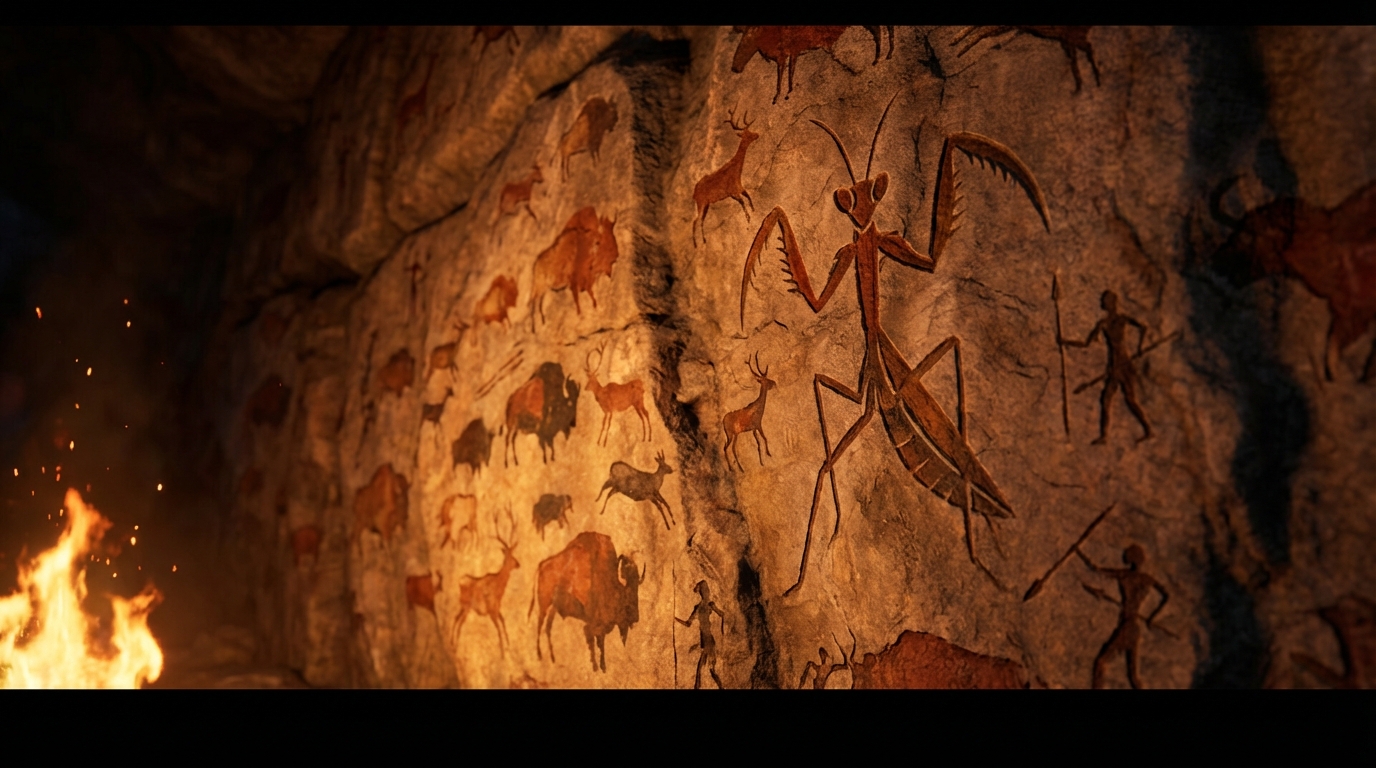
Ancient Petroglyphs: 40,000 Years of the Same Image
“The figure is unmistakable. A humanoid form with a triangular head, elongated limbs, and what appear to be folded appendages — exactly like a praying mantis standing upright. It is carved into rock that dates to between 4,000 and 40,000 years ago.”
— Description of the Teymareh petroglyph, Khomein County, IranIn 2020, entomologists examining a petroglyph site in Teymareh, Iran, identified a six-limbed figure carved into rock that bears a striking resemblance to a praying mantis — but standing upright, in a humanoid posture. The carving dates to somewhere between 4,000 and 40,000 years ago. It is not alone. The San people of southern Africa — one of the oldest continuous cultures on Earth — have depicted mantis-like beings in their rock art for thousands of years. In San cosmology, the mantis is not merely an insect. It is a creator god, a trickster deity, a being of immense power called /Kaggen who moves between worlds. Half a world away, separated by millennia and oceans, ancient Iranians carved the same figure into stone. The San painted it on cave walls. And modern abductees, who have never seen either, describe it on operating tables in spacecraft. The question is not whether these images resemble each other. They obviously do. The question is why.
Global Reports: The Same Being, Every Continent
“I have investigated cases from Phoenix, Arizona; rural England; the Amazon basin in Brazil; and western Canada. The descriptions are functionally identical. Seven to nine feet tall. Triangular head. Dark, chitinous skin. Long, thin limbs that bend at angles human limbs cannot. And always that sense of ancient, patient intelligence.”
— Composite of investigator field notesThe Mantis Beings are not confined to a single culture or region. Reports come from Phoenix, Arizona, where witnesses describe towering insectoid figures during the famous 1997 lights event. From rural England, where solitary encounters in fields and woodlands produce drawings that match American abduction accounts. From the Amazon basin in Brazil, where indigenous ayahuasca traditions describe insectoid intelligences that oversee the spirit world. From Alberta and British Columbia in Canada, where First Nations accounts and modern sightings converge on the same description. The geographic spread is vast. The cultural contexts are completely different. And yet the being described is always the same: seven to nine feet tall, triangular head, dark exoskeleton, long spindly limbs, an air of absolute authority.
Of all the beings reported in the alien contact landscape, the Mantis Beings may be the most deeply strange. Not because they are the most frequently seen — they are not. Not because they are the most aggressive — accounts vary. But because they violate our deepest assumptions about what intelligence should look like. We can imagine humanoid aliens. We can even imagine reptilian ones. But an insect — a praying mantis, scaled up to nine feet, wearing robes, directing operations, communicating telepathically — that is something the human imagination resists. And yet the reports persist.
Physically, the descriptions are remarkably consistent. A triangular head dominated by large, dark, compound-looking eyes. A body covered in what witnesses describe as a dark exoskeleton or chitinous skin, usually black or very dark green. Long, thin limbs that bend at unexpected angles, with joints that seem to articulate differently from mammalian anatomy. Hands with elongated fingers — three or four, depending on the account. And frequently, robes. Colored robes: purple, dark red, or gold, possibly indicating rank or function within their hierarchy. The robes are a curious detail. Why would an insectoid species wear clothing? Some contactees suggest the robes are not fabric but a form of energy field made visible. Others take them at face value — ceremonial garments worn by beings who have long since transcended biological necessity.
Their role in the abduction scenario is almost always the same: oversight. They watch. They direct. They make decisions. Some abductees report that a Mantis Being intervened when a procedure became too painful or too dangerous, issuing a silent command that caused the Greys to stop. Others describe less benevolent encounters — cold, clinical observation with no apparent concern for the subject’s distress. The consensus, if there is one, is that the Mantis Beings view their work as important enough to justify whatever discomfort it causes. They are described as ancient, patient, and utterly focused on a project whose scope and purpose they do not explain.
Some contactees go further, describing the Mantis Beings as master geneticists — beings who have been engineering biological life across the galaxy for millions of years. In this framework, they are not merely observers of humanity but architects of it, tending a genetic experiment that spans epochs. The Greys, in this telling, are their instruments — biological constructs designed for the hands-on work while the Mantids oversee the larger design. This is speculative territory, obviously. But it offers a framework for why these beings appear so consistently in both ancient art and modern accounts.
The most unsettling question about the Mantis Beings is not whether they are real. It is this: why do ancient petroglyphs on opposite sides of the world — carved by cultures with no contact with each other, separated by tens of thousands of years — depict the same insectoid beings that modern abductees describe under hypnotic regression? The San of Africa painted them. The ancients of Iran carved them. The abductees of Phoenix and London and São Paulo draw them. The image is always the same. Something is being remembered. The only question is what.
Further Reading
- David M. Jacobs — The Threat
- Budd Hopkins — Missing Time
- Teymareh petroglyph study — Journal of Entomological Science (2020)
- San rock art & /Kaggen mythology — Iziko South African Museum archives
- Simon Wilson — Mantis encounters in British case files