Andromedans
Watchers from the Nearest Galaxy
Alex Collier’s Contact
“They told me that the love we withhold is the pain we carry. That every act of suppression, every time we deny what we feel to conform to someone else’s expectation, we lose a piece of ourselves. They said Earth’s greatest problem is not technology, not politics — it’s that we have been taught to betray ourselves.”
— Alex Collier, Defending Sacred GroundAlex Collier claims his contact with two Andromedan beings — Morenae and Vissaeus — began in childhood and continued for decades. What makes his accounts notable is not just their duration but their depth. Collier did not describe fleeting encounters or ambiguous lights. He described extended conversations about Andromedan history, their social structure, their technology, their view of Earth’s situation. He provided details about a 4.5-billion-year-old civilization that had survived a catastrophic civil war, abandoned hierarchical governance, and rebuilt itself around a principle he translated simply as “the isness” — the idea that all consciousness is fundamentally connected and equally valid. Whether you believe Collier or not, the internal consistency of his accounts over decades is, at minimum, remarkable.
The Biosphere Ships
“Their ships are not vehicles in the way we think of them. They are living environments — entire ecosystems. Forests, bodies of water, wildlife. Some are hundreds of miles in diameter. The Andromedans do not travel through space — they carry their world with them.”
— Alex Collier, lecture transcriptsOne of the most striking details in Andromedan contactee lore is the description of their spacecraft — or rather, their biospheres. These are not the cold metallic discs of classic UFO imagery. According to multiple accounts, Andromedan vessels are enormous self-sustaining ecosystems: living ships containing forests, oceans, mountains, and diverse wildlife. Some are described as being hundreds of miles across. The beings themselves do not live on planets in the traditional sense but have become a spacefaring civilization that carries its biosphere with it. The concept is fascinating not because it is provable, but because it anticipates ideas that human scientists would later explore seriously — O’Neill cylinders, generation ships, closed-loop ecosystems. Did contactees independently arrive at the same engineering conclusions as NASA theorists? Or were they shown something?
Co-Founders of the Galactic Federation
“The Council was formed after the Orion Wars, when it became clear that no single species could maintain balance alone. The Andromedans, Lyrans, and Arcturians were among the founding members — not as rulers, but as mediators. Their role is to inspire self-determination, never to impose.”
— Compiled from multiple contactee sourcesIn the broader narrative of alleged extraterrestrial politics, the Andromedans are consistently placed as co-founders and senior members of the Galactic Federation alongside the Lyrans and Arcturians. Their role is described not as governance but as guidance — they observe, they advise, they occasionally intervene when the balance of an entire region of space is threatened. Multiple independent contactees describe a non-interference principle similar to Star Trek’s Prime Directive, which they attribute to hard lessons learned during the ancient Orion conflicts. The Andromedans supposedly advocate for younger civilizations to find their own path, even when that path involves suffering. The philosophy is consistent and coherent enough to function as a genuine worldview — whether its origin is extraterrestrial or entirely human.
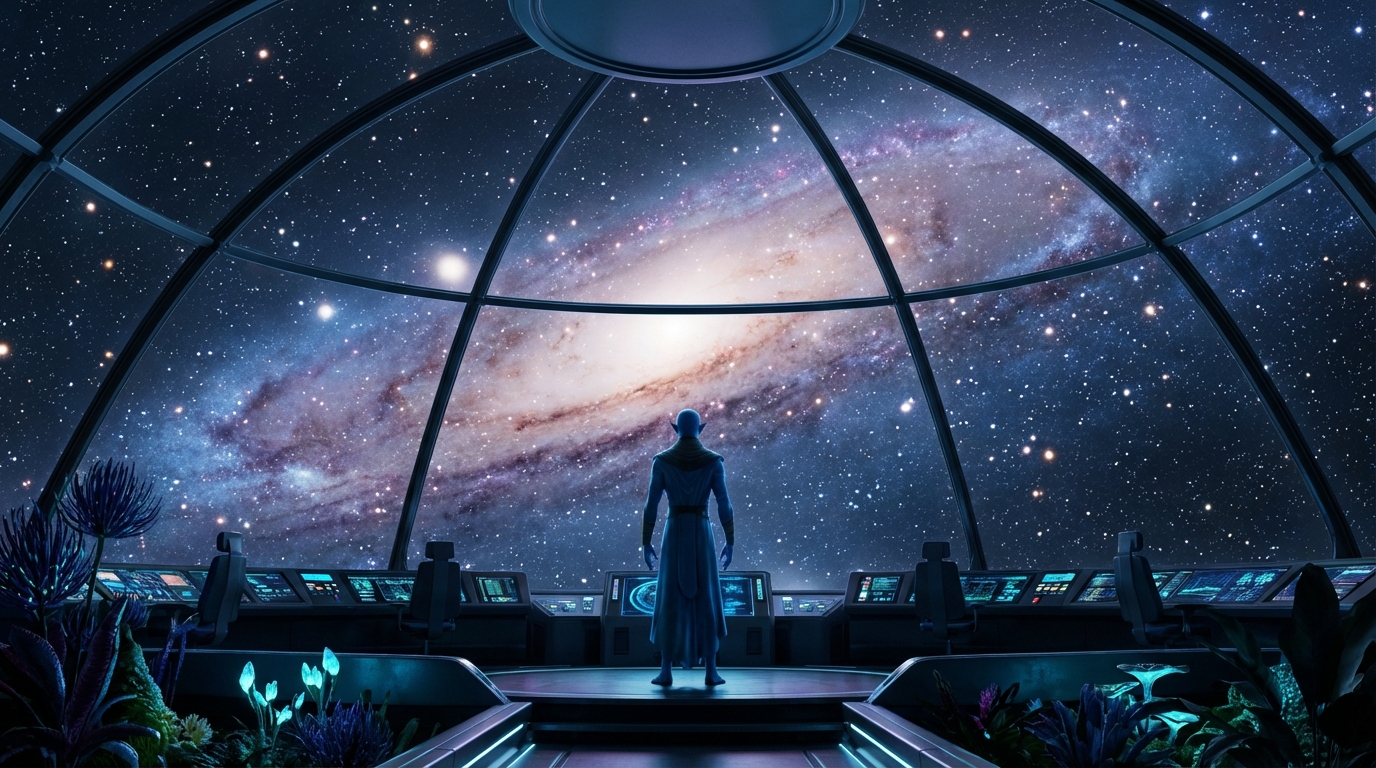
Two and a half million light-years away, the Andromeda Galaxy hangs in the autumn sky — a smudge of light visible to the naked eye, the most distant object a human can see without a telescope. It contains roughly a trillion stars. And according to a persistent thread in contactee literature, it is home to one of the oldest and most philosophically advanced civilizations in the local universe.
The Andromedans are described as tall — ranging from six and a half feet to, in some accounts, sixteen feet or more, though most reports center around eight feet. Their skin is pale or sky blue, sometimes described as faintly luminous. They have no body hair. Their features are humanoid but refined, with high foreheads and large, expressive eyes. They move with a deliberateness that contactees often describe as graceful or ceremonial. Their presence is said to radiate calm — not the cold detachment of the Greys, but a warm, almost parental reassurance.
Their history, as conveyed through contactees, is one of near-destruction and rebirth. An ancient civil war — fought not over resources but over ideology — nearly destroyed their civilization. The survivors made a collective decision to rebuild on the foundation of empathy rather than control. Over billions of years, this choice compounded. They developed technology that interfaces directly with consciousness. They abandoned permanent planetary settlements in favor of biosphere ships that travel the galaxy as living worlds. They structured their society around individual sovereignty — no rulers, no subjects, only beings making free choices within a web of mutual respect.
The philosophical content attributed to the Andromedans is perhaps their most intriguing aspect. They reportedly teach that consciousness creates reality, that fear is the only real prison, and that Earth’s current crisis is fundamentally a crisis of self-betrayal — a civilization that has been convinced to deny its own nature. These ideas are not unique to contactee literature; they echo across spiritual traditions worldwide. But the way they are framed — as practical observations from a civilization that has been through its own dark age and emerged — gives them a distinctive weight.
The persistent question: why do independent contactees, separated by years and continents, describe the same beings with the same philosophy and the same history? Coincidence explains some of it. Cultural cross-pollination explains more. But the residue that remains after you account for both — that narrow gap between what can be explained and what cannot — is where the real mystery lives.
Further Reading
- Alex Collier — Defending Sacred Ground
- Alex Collier — Letters from Andromeda
- Tolec — Andromeda Council material