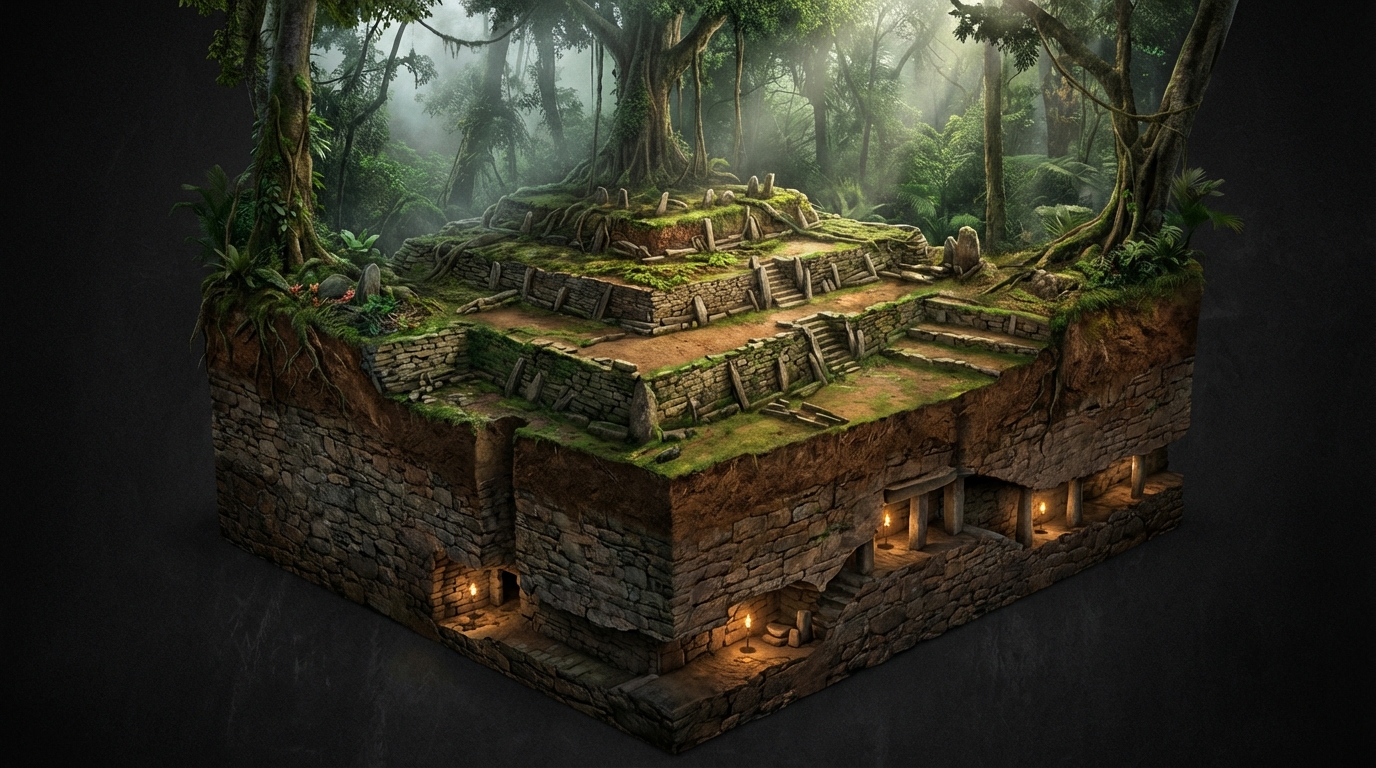
Gunung Padang
The World’s Oldest Pyramid?
The Paper That Shook Archaeology
“Our studies strongly suggest that Gunung Padang is not a natural hill but a man-made pyramid, with construction beginning during the last glacial period, possibly as early as 27,000 years ago.”
— Natawidjaja et al., Archaeological Prospection, October 2023In October 2023, geologist Danny Hilman Natawidjaja and a team of Indonesian researchers published a peer-reviewed paper in Archaeological Prospection — a Wiley journal — that made a claim so extraordinary it sent shockwaves through the archaeological world. Using ground-penetrating radar, seismic tomography, core drilling, and radiocarbon dating, the team argued that Gunung Padang, a terraced megalithic site in West Java long known as Indonesia’s largest prehistoric structure, was not built on a natural hill. It was the hill — a massive, multi-layered pyramid whose deepest construction layers dated to 27,000 years ago, with additional phases at 14,000–12,000 and 7,500–5,000 years before present.
The Retraction
“The editors have concluded that the article does not provide sufficient evidence to support the claims made… The radiocarbon dates may reflect natural soil formation rather than human construction activity.”
— Archaeological Prospection, retraction notice, 2024The backlash was immediate and fierce. Archaeologists pointed out that the radiocarbon dates were obtained from soil samples between stones, not from the stones themselves — meaning the dates might reflect natural geological deposits rather than human construction. The columnar basalt that makes up Gunung Padang’s terraces occurs naturally in volcanic regions; the “construction” could be a volcanic neck or natural rock formation that later cultures built upon. In 2024, Archaeological Prospection retracted the paper, citing insufficient evidence for its central claims. The retraction was, by any measure, a significant blow.
What the Retraction Did Not Explain
“Whether this is a pyramid or a volcano, the fact remains: someone carved and moved these columnar stones into deliberate arrangements. The surface terraces are clearly constructed. The only question is how deep the construction goes — and when it began.”
— Danny Hilman Natawidjaja, post-retraction interviews, 2024But a retraction is not a refutation. The paper was withdrawn because the evidence was deemed insufficient, not because it was proven wrong. The seismic tomography data still shows anomalous cavities and voids beneath the surface that are difficult to explain as purely natural formations. The core samples still contain layers of clay, iron, and silica in compositions that suggest high-temperature processing — metallurgical signatures that, if confirmed, would predate the conventional Iron Age by millennia. And the surface terraces themselves — five tiers of carefully arranged columnar basalt blocks rising to 885 meters elevation — are unambiguously constructed, even if their age remains contested.
Gunung Padang sits in the Karyamukti village of Cianjur regency, surrounded by tea plantations and volcanic peaks. To the local Sundanese population, it has always been sacred — a place of power, avoided after dark, associated with stories of an ancient king who tried to build a palace in a single night. Dutch colonial archaeologists catalogued the surface megaliths in 1914 but dismissed the site as a simple terraced shrine. For nearly a century, that was the official verdict. Nobody looked deeper.
Natawidjaja began his investigations in 2011, initially as a geological survey. What he found beneath the surface changed his direction entirely. Ground-penetrating radar revealed structured layers extending far below the visible terraces — chambers, walls, and voids that appeared to be constructed rather than natural. Core drilling extracted samples from these deeper layers, and the radiocarbon dates that came back were staggering: some material from the deepest layers dated to 27,000 years before present. If those dates represent human construction — and that remains the critical “if” — then Gunung Padang would be the oldest known man-made structure on Earth by a factor of three.
The mainstream interpretation is that Gunung Padang is a natural volcanic formation — a columnar basalt neck — that ancient peoples terraced and arranged on its upper surfaces, probably within the last few thousand years. The deeper layers, in this reading, are simply geology. The radiocarbon dates reflect organic material trapped in natural soil deposits, not evidence of construction. This explanation is tidy, parsimonious, and may well be correct.
But it does not account for everything. It does not explain the seismic anomalies. It does not explain the composition of the clay-iron-silica layers found at depth. It does not explain why the columnar stones at Gunung Padang show evidence of having been cut to uniform lengths and arranged in patterns that do not match known natural basalt formations in the region. And it does not address the broader context: that Southeast Asia, during the Last Glacial Maximum, was a very different landscape — a vast, exposed continental shelf with river systems, forests, and conditions suitable for complex societies. If anyone was building 27,000 years ago, this is one of the places they might have built.
The retraction killed the headline. It did not kill the question. Gunung Padang remains the most intensely debated archaeological site in Southeast Asia, and the debate is far from settled. What lies beneath those terraces — geology or architecture, accident or intention — is a question that can only be answered by more digging. And so far, the deeper anyone digs, the more interesting the answers become.
Sources & Further Reading
- Natawidjaja et al. — “Geo-archaeological prospecting of Gunung Padang,” Archaeological Prospection (2023, retracted 2024)
- Danny Hilman Natawidjaja — fieldwork reports, Indonesian Institute of Sciences (LIPI)
- Lutfi Yondri — “Gunung Padang: A Megalithic Site in West Java,” National Research Centre for Archaeology, Indonesia
- Ali Akbar — “The Archaeology of Gunung Padang” (University of Indonesia)
- Archaeological Prospection — retraction notice and editorial response (2024) — see also Gunung Padang (Wikipedia)