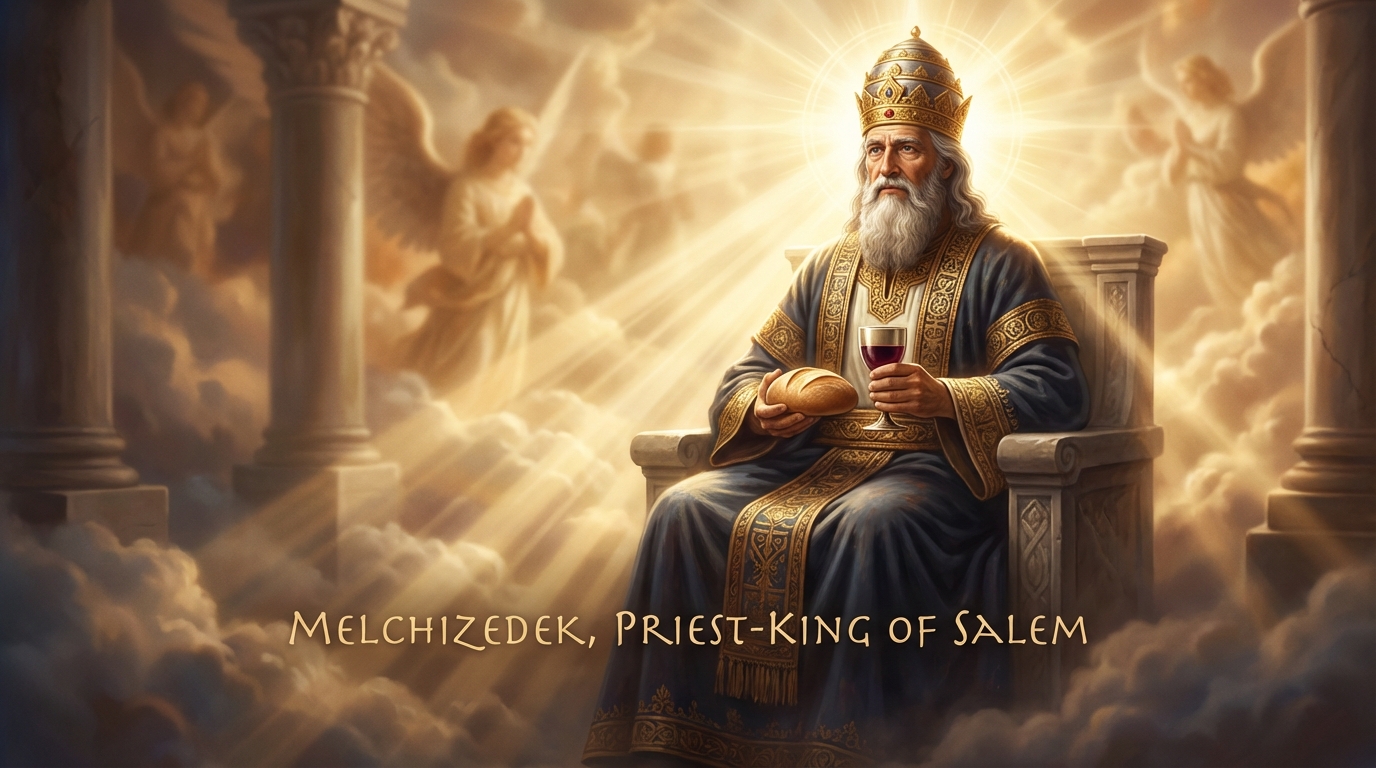
Melchizedek
The Eternal Priest-King
Hebrews 7:3
He is without father or mother or genealogy, having neither beginning of days nor end of life, but resembling the Son of God he continues a priest forever.
— Hebrews 7:3 (ESV)11Q13 (Melchizedek Scroll) Col. II
And Melchizedek will carry out the vengeance of God’s judgments, and on that day he will free them from the hand of Belial and from the hand of all the spirits of his lot.
— 11Q13 II:13 (Dead Sea Scrolls)Melchizedek first appears in Genesis 14 as the mysterious king of Salem and “priest of God Most High” who blesses Abraham and receives a tithe from him — an extraordinary act given Abraham’s stature. He arrives without introduction and vanishes without explanation. No father, no mother, no genealogy. In the ancient world, where identity was defined by lineage, this silence was deafening.
Psalm 110:4 invokes him again: “You are a priest forever after the order of Melchizedek.” The author of Hebrews builds an extended argument on this verse, presenting Melchizedek as a type of Christ — a priest whose authority predates and surpasses the Levitical priesthood precisely because it has no origin and no end.
The Dead Sea Scrolls take this further. In the Melchizedek Scroll (11Q13), he is elevated to a heavenly figure of immense power — an angelic judge who will execute God’s vengeance in the final jubilee, liberating the righteous from the dominion of Belial. The text applies divine titles to him, including “Elohim,” suggesting the Qumran community saw Melchizedek as far more than a historical king. He stands at the intersection of priest, king, judge, and angel — a figure who refuses every category.
Further Reading
- Genesis 14:18–20
- Psalm 110:4
- Hebrews 5:5–10
- Hebrews 7:1–28
- 11Q13 (Melchizedek Scroll)