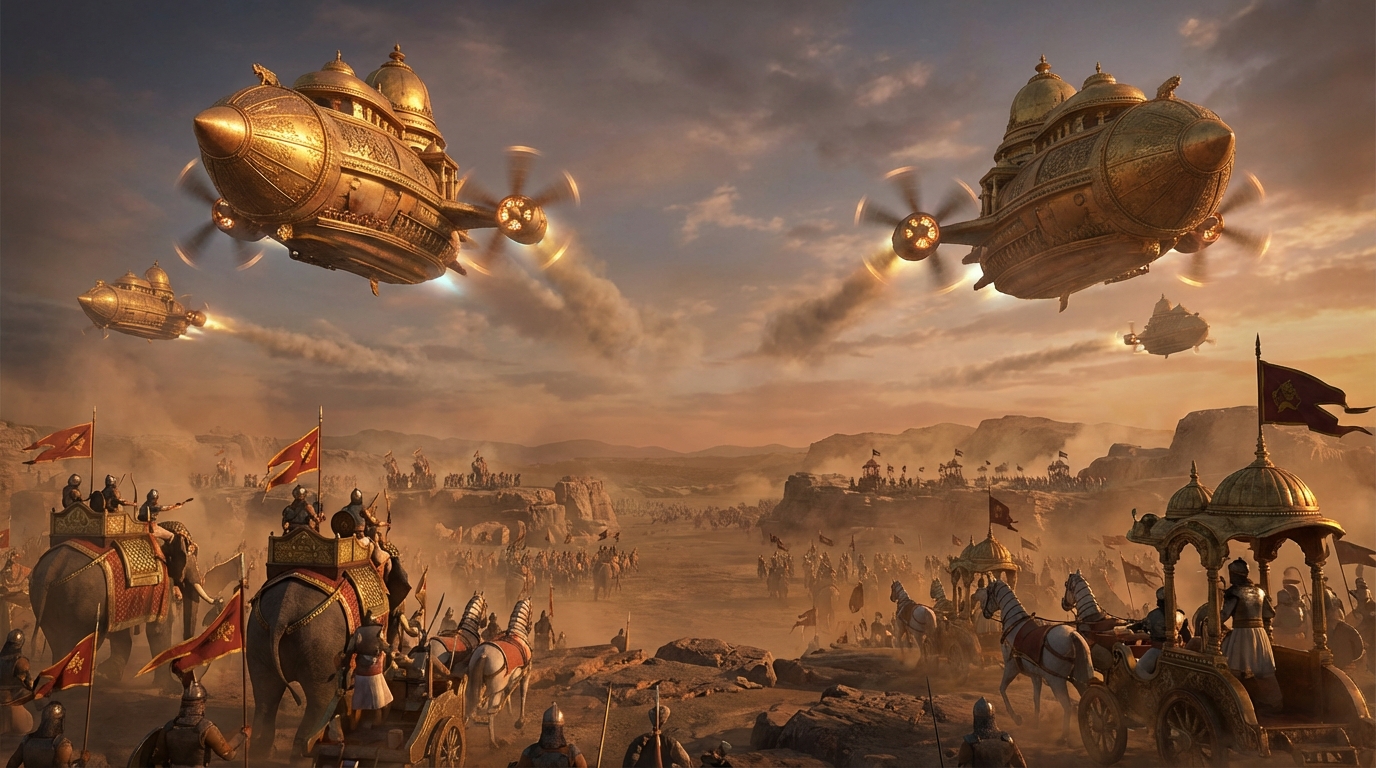
Vimanas
Ancient Flying Machines of the Vedas
The Pushpaka Vimana
“The Pushpaka chariot that resembles the Sun and belongs to my brother was brought by the powerful Ravana; that aerial and excellent chariot going everywhere at will… that chariot resembling a bright cloud in the sky.”
— Ramayana, Valmiki (c. 5th century BCE), Yuddha Kanda, canto 123The Ramayana, one of the two great Sanskrit epics of ancient India, describes a flying vehicle called the Pushpaka Vimana in terms that are difficult to reconcile with mere poetic imagination. This was not a chariot pulled by winged horses or a magic carpet propelled by enchantment. The text describes it as a vehicle that “goes everywhere at will,” that could change its form, that was “wide and roomy as a large city,” with multiple stories, windows, and chambers. It moved through the air at the speed of wind. The Ramayana describes its appearance as resembling a bright cloud or the sun itself — luminous, hovering, self-propelled. Rama uses it to fly from Lanka (Sri Lanka) to Ayodhya after defeating Ravana, and the text describes the landscape passing below as seen from above — an aerial perspective that an ancient writer should not have been able to imagine with such precision.
Four Types of Craft
“The Sundara vimana is rocket-shaped. The Rukma is conical, made of gold. The Sakuna is bird-shaped. The Tripura is three-storied, capable of operating in air, water, and land.”
— Vaimanika Shastra, classification of vimana types (Josyer translation, 1973)The ancient Indian texts do not describe one flying machine — they describe an entire taxonomy. The Vaimanika Shastra, a text dictated between 1918 and 1923 by Pandit Subbaraya Shastry (who claimed to have channeled it from ancient sources), categorizes vimanas into four distinct types: the Sundara, which is rocket-shaped; the Rukma, which is conical and golden; the Sakuna, which is bird-shaped and designed for long-range flight; and the Tripura, which is three-storied and capable of operating in three mediums — air, water, and on land. A 1974 study by the Indian Institute of Science in Bangalore examined the Vaimanika Shastra’s technical specifications and concluded that the described vehicles would not be aerodynamically viable. The modern text, they determined, is not a genuine ancient engineering manual.
The Ancient Descriptions
“An aerial chariot, the Pushpaka, conveys many people to the capital of Ayodhya. The sky is full of stupendous flying machines, dark as night, but picked out by lights with a yellowish glare.”
— Mahabharata (c. 4th century BCE), translated passagesBut here is where it gets interesting. The Vaimanika Shastra may be a 20th-century composition — but the ancient descriptions in the Ramayana and Mahabharata are genuinely old, predating the common era by centuries. And those ancient descriptions are the remarkable part. The Mahabharata describes aerial vehicles that are “dark as night” but illuminated by “lights with a yellowish glare.” It describes aerial combat — vimanas deploying weapons that produce blinding light and devastating heat. The Samarangana Sutradhara, an 11th-century text attributed to King Bhoja, contains an entire chapter on the construction of mechanical devices, including aerial machines, with descriptions of mercury-based propulsion systems. These are not vague mythological references. They are specific, technical, and consistent across multiple texts spanning centuries.
The conventional explanation is straightforward: vimanas are mythological vehicles, products of the same human imagination that gave us Pegasus and the flying chariots of Greek gods. Every culture dreams of flight, and the Indian literary tradition — one of the richest in human history — simply dreamed with more detail and engineering vocabulary than most. The 1974 IIS study effectively debunked the Vaimanika Shastra as a modern composition with no practical aeronautical merit. Case closed.
Except the case is not closed, because the debunking addresses the wrong text. The Vaimanika Shastra, with its 20th-century provenance, is the weakest link in the vimana tradition — and it is the one that critics love to demolish. The genuinely ancient references in the Ramayana and Mahabharata are far more difficult to dismiss. These are not fringe texts. They are the foundational epics of Indian civilization, composed and transmitted over centuries by a culture that produced extraordinary achievements in mathematics, astronomy, medicine, and metallurgy. The people who wrote these descriptions were not naive fantasists. They were scholars.
Consider the details that recur across the ancient texts: circular or dome-shaped craft. Multiple levels or stories. Windows or portholes. Self-luminosity. The ability to hover, to move in any direction, to travel at tremendous speed. Weapons that produce blinding light and intense heat. These descriptions do not sound like mythologized chariots. They sound like something else entirely — something the ancient writers were struggling to describe with the vocabulary available to them. A craft that resembles “a bright cloud in the sky,” that is “wide and roomy as a large city,” that moves “everywhere at will” — what, exactly, is being described?
The honest answer is: we do not know. The ancient Indian vimana descriptions may be nothing more than the vivid imaginings of a literary tradition without parallel. Or they may be cargo-cult descriptions of technology observed but not understood — memories encoded in epic poetry because that was the only recording medium available. The Vaimanika Shastra is a modern dead end. But the Ramayana is 2,500 years old, and its descriptions of flying craft remain as vivid and specific and strange as the day they were composed. That, at minimum, deserves our curiosity.
Sources & Further Reading
- Valmiki — Ramayana (c. 5th century BCE), multiple translations
- Vyasa (attributed) — Mahabharata (c. 4th century BCE), multiple translations
- G.R. Josyer — Vaimanika Shastra, translation and commentary (1973)
- Indian Institute of Science, Bangalore — “A Critical Study of the Work Vymanika Shastra” (1974)
- King Bhoja (attributed) — Samarangana Sutradhara (11th century CE), chapter on yantras
- David Hatcher Childress — Vimana Aircraft of Ancient India & Atlantis (1991)