Aboriginal Oral Histories
Seven Thousand Years of Perfect Memory
When the Sea Swallowed the Land
“Aboriginal stories about coastal inundation, many of which we took to be myths, are in fact accounts of real events that occurred between about 7,000 and 12,000 years ago. This is by far the longest record of accurate oral history ever documented.”
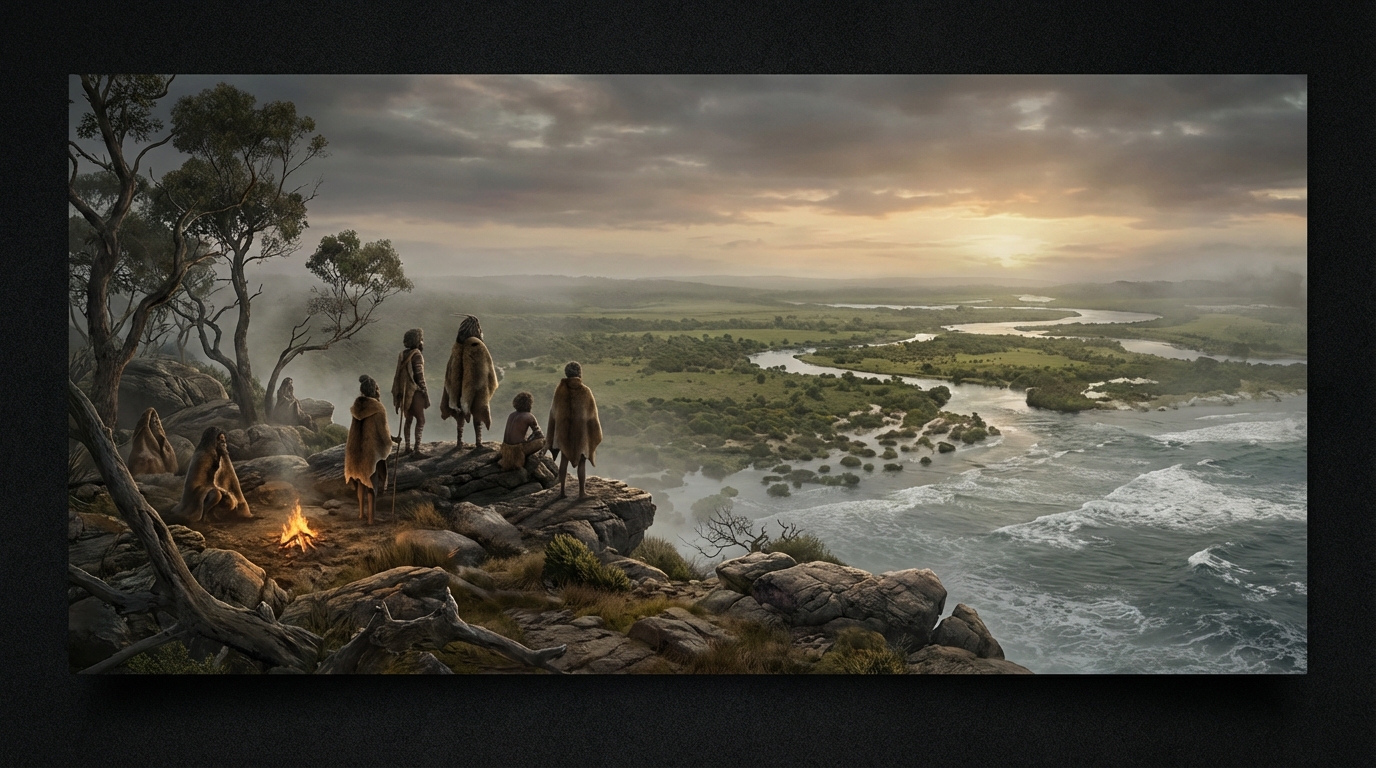
— Patrick Nunn, Professor of Geography, University of the Sunshine Coast, 2015At more than 21 coastal locations around Australia, Aboriginal communities maintain oral traditions describing a time when the sea rose and swallowed lands where their ancestors had walked, hunted, and lived. These are not vague flood myths. They are specific. They name particular places — islands that were once hills, reefs that were once plains, stretches of coastline that extended far beyond where the water now reaches. For decades, Western scholars treated these stories as mythology. Then geologists and marine archaeologists began mapping the post-glacial sea level rise around Australia. What they found was extraordinary: the Aboriginal accounts matched the geological evidence with remarkable precision. Lands described as lost in the stories are exactly where the seafloor surveys show submerged terrain.
Verified by Geology
“We found that in all 21 communities, the oral traditions describe events consistent with post-glacial sea-level rise between 7,000 and approximately 12,800 years ago. These traditions have been maintained with astonishing fidelity across at least 300 generations.”
— Nick Reid & Patrick Nunn, “Aboriginal Memories of Inundation of the Australian Coast,” Australian Geographer (2015)The research of linguist Nick Reid and geographer Patrick Nunn systematically compared Aboriginal oral traditions with geological and oceanographic data. The results were striking. Traditions from the Narungga people of South Australia describe Yorke Peninsula as once being connected to what are now offshore islands. Geological evidence confirms this. Torres Strait Islander traditions describe walking between Australia and Papua New Guinea across land now submerged beneath the strait — land that was indeed above water during the last glacial period. The Gunditjmara people of Victoria describe volcanic eruptions that geologists have dated to between 5,000 and 37,000 years ago. In each case, the oral tradition preserves accurate information about events that occurred thousands of years before writing was invented anywhere on Earth.
The Mechanism of Memory
“In Aboriginal Australian cultures, the preservation of knowledge was not casual. It was a rigorous, formal process involving designated knowledge-keepers, cross-generational verification, and severe consequences for error.”
— Patrick Nunn, The Edge of Memory (2018)How does any culture maintain accurate information across 7,000 or more years without writing? The answer lies in the extraordinary knowledge-transmission systems developed by Aboriginal Australians over tens of thousands of years of continuous cultural practice. Information was not simply told and retold casually. It was embedded in songlines — navigational paths across the landscape encoded in song, story, and ceremony. Designated knowledge-keepers were trained over years, and their recitations were cross-checked by elders from neighboring groups who held overlapping portions of the same traditions. Errors were not merely corrected — they carried serious social and sometimes ritual consequences. The harsh Australian environment, where precise knowledge of water sources, seasonal patterns, and landscape features was literally a matter of survival, provided a powerful selection pressure for accuracy.
This is not speculative. This is not a “what if.” This is verified. Australian Aboriginal oral traditions have been confirmed by modern geology, marine archaeology, and volcanology to preserve accurate memories of events that occurred between 7,000 and 12,000 years ago. Three hundred generations of human beings passed this information forward, mouth to ear, elder to initiate, song to song, with sufficient fidelity that 21st-century scientists can match the stories to the geological record. No other culture on Earth has demonstrated anything remotely comparable. The oldest written records — Sumerian cuneiform — date to roughly 5,000 years ago. Aboriginal Australians were already carrying memories twice that old.
The implications extend far beyond Australia. If one culture can maintain accurate oral histories for 7,000 years, what about others? The flood traditions that appear across nearly every ancient civilization — Sumerian, Hebrew, Greek, Indian, Chinese, Mesoamerican — are typically dismissed as mythological elaborations on local flooding events. But if oral traditions can demonstrably preserve accurate information across seven millennia or more, then the global flood narrative deserves a second look. Not necessarily as evidence of a single worldwide deluge, but as a collection of independently maintained memories of real events — the dramatic post-glacial sea level rise that reshaped every coastline on Earth between 15,000 and 7,000 years ago.
Aboriginal Australians represent the longest continuous culture on the planet, with archaeological evidence of occupation extending back at least 65,000 years. Their knowledge systems predate agriculture, writing, metalworking, and every other hallmark of what Western scholars call “civilization.” And yet those systems worked — worked well enough to preserve accurate geological data across a span of time that makes recorded history look like a footnote. We have had writing for 5,000 years and already struggle to read texts from 2,000 years ago. They maintained precision across 7,000 years using only the human voice and the human mind.
The question that haunts this research is simple: what else do they remember? If Aboriginal traditions accurately encode geological events from 7,000 to 12,000 years ago, what about the traditions that describe events further back — events we cannot yet verify because we have not looked in the right places, or because the evidence lies deep underwater on continental shelves we have barely surveyed? The longest memory on Earth is still speaking. We might consider listening more carefully.
Sources & Further Reading
- Patrick Nunn — The Edge of Memory: Ancient Stories, Oral Tradition and the Post-Glacial World (Bloomsbury, 2018)
- Nick Reid & Patrick Nunn — “Aboriginal Memories of Inundation of the Australian Coast Dating from More than 7000 Years Ago,” Australian Geographer (2015)
- Duane Hamacher — Australian Aboriginal Astronomy project, research papers
- Ray Norris & Duane Hamacher — “Australian Aboriginal Astronomy: Overview and Future Directions,” Publications of the Astronomical Society of Australia
- Clarkson et al. — “Human occupation of northern Australia by 65,000 years ago,” Nature (2017)
- Lynne Kelly — The Memory Code (2016), on indigenous knowledge-preservation systems