Lyrans
The First Humans
The Meier Transmissions
“The human races of the Lyra system were the first to develop in our region of the galaxy. They are the ancestors of all humanoid life — the Pleiadians, the Sirians, and the human beings of Earth. They are the original seed.”
— Attributed to Billy Meier’s Pleiadian contact notes, 1970sEvery family tree has a root. In the sprawling mythology of extraterrestrial species — Pleiadians, Sirians, Arcturians, and dozens more — virtually every account traces the lineage back to the same place: the Lyra constellation. The Lyrans are described as the original humanoid species, the ancient progenitors from whom all human-like life in the galaxy ultimately descended. If this framework is even partially true, it means looking up at Vega — the brightest star in Lyra, the fifth brightest in our sky — is looking toward the birthplace of humanity itself.
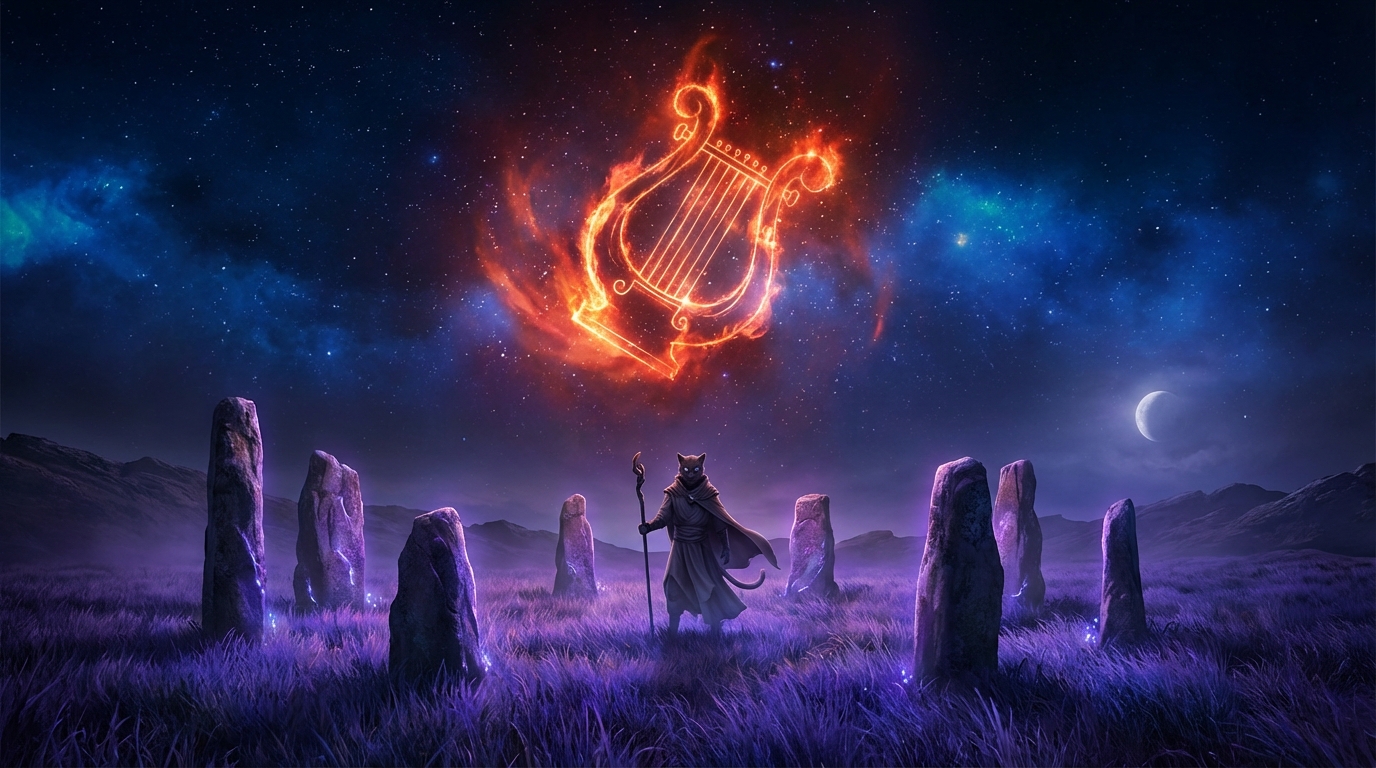
The earliest Lyrans are described as distinctly feline in appearance. Cat-like features: elongated faces, slit pupils, tufted ears, and a predatory grace that echoes through every ancient culture’s reverence for big cats. Over vast stretches of time, the accounts say, different Lyran lineages evolved in different directions. Some retained their feline characteristics. Others became more conventionally humanoid — taller, lighter, eventually becoming what contactees now call the Pleiadians and the Nordics. The idea is staggering in its scope: a single species, radiating outward across the galaxy over millions of years, seeding world after world, adapting, diverging, and occasionally returning to check on the younger branches of their family tree.
Billy Meier, the controversial Swiss contactee, brought the Lyran narrative into modern UFO discourse through his alleged communications with Pleiadian beings beginning in the 1970s. According to Meier’s accounts, the Pleiadians themselves acknowledged their Lyran ancestry and described the Lyra system as the cradle of humanoid civilization. Whatever one makes of Meier’s claims — and they are fiercely debated — the Lyran origin story he described became foundational to an entire framework of extraterrestrial taxonomy that persists to this day.
The Lyrans are also identified as co-founders of the Galactic Federation, the alleged alliance of benevolent species said to oversee the development of younger civilizations. In this telling, the Lyrans are the elders — the species that learned the hardest lessons first, survived their own wars and near-extinction events, and emerged with the wisdom to guide rather than conquer. They are described as having a particular investment in Earth, viewing humanity as a young offshoot of their own ancient lineage, stumbling through the same growing pains they once endured.
The question at the heart of the Lyran narrative is one of the most profound in all of ufology: did human-like life originate in the Lyra constellation and seed the galaxy? It sounds like science fiction. But then again, the panspermia hypothesis — the idea that life spreads between star systems — is a legitimate scientific concept, discussed seriously by researchers from Fred Hoyle to Francis Crick. The Lyran story simply takes that idea to its logical extreme. And if you accept even the possibility, it reframes everything: we are not isolated. We are not an accident. We are the youngest members of a very old family, and the elders may still be watching.
Further Reading
- Billy Meier — Pleiadian/Plejaren contact notes
- Lyssa Royal — The Prism of Lyra
- Panspermia hypothesis — Hoyle, Wickramasinghe, Crick
- Vega and the Lyra constellation in ancient astronomy