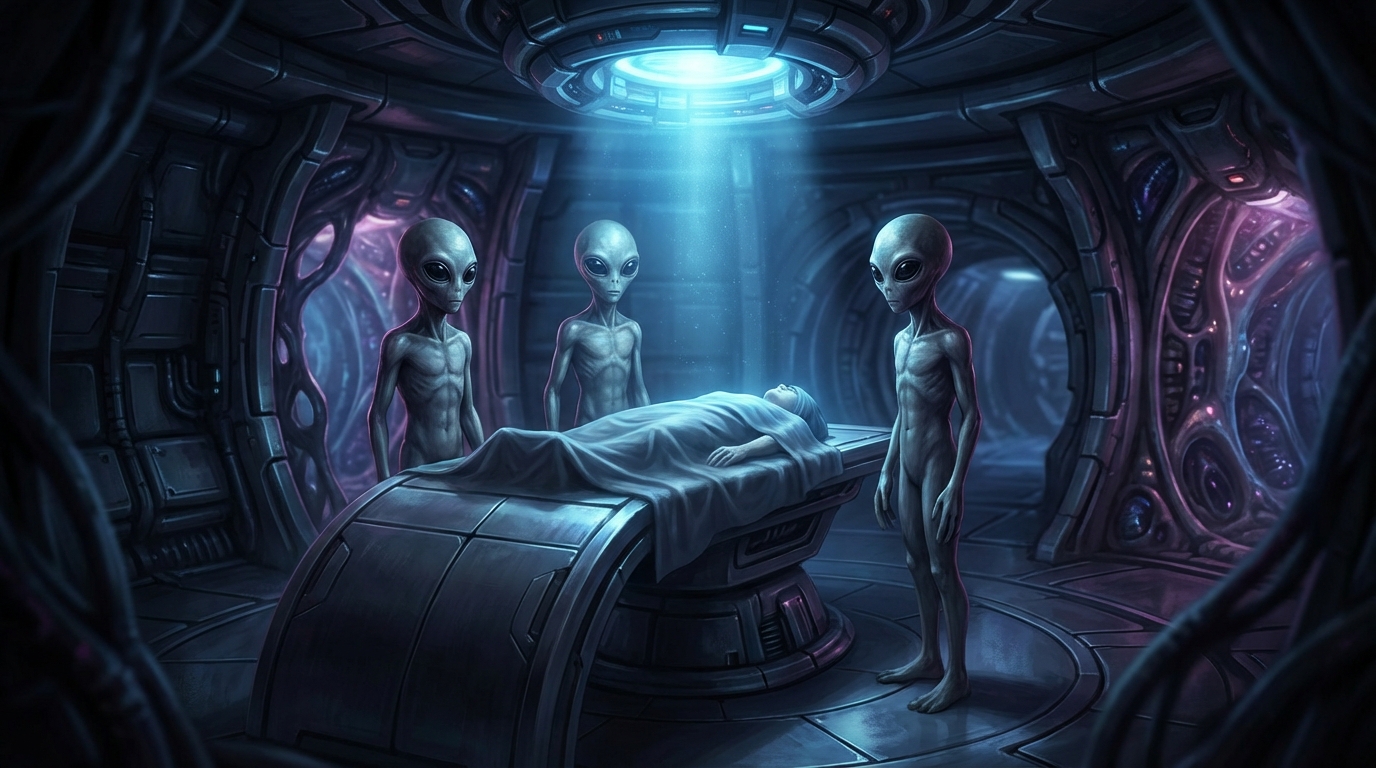
Greys
The Zeta Reticulans
The Hill Abduction (1961)
“There were these huge eyes staring at me. They were large, dark, and slanted upward. I felt like they could see right through me — not just what I looked like, but what I was thinking.”
— Betty Hill, recounting the encounter under hypnosis, 1964On the night of September 19, 1961, Betty and Barney Hill were driving through the White Mountains of New Hampshire when they noticed a bright, erratically moving light in the sky. What followed would become the most thoroughly documented alien abduction case in history. Under separate hypnosis sessions conducted by Dr. Benjamin Simon, both Betty and Barney independently described being taken aboard a craft by short, grey-skinned beings with enormous wraparound eyes. The beings communicated telepathically and conducted what appeared to be medical examinations.
Perhaps the most intriguing detail emerged from Betty’s account: she described being shown a “star map” by the leader of the beings. In 1968, amateur astronomer Marjorie Fish built a three-dimensional model of nearby sun-like stars and found a pattern that matched Betty’s drawing — pointing directly to the Zeta Reticuli system, a pair of sun-like stars 39 light-years away. The match was precise enough that it was published in Astronomy magazine. Skeptics have challenged Fish’s methodology, but the question lingers: how did Betty Hill draw a map of stars she had never heard of?
Roswell (1947)
“The wreckage was scattered over a wide area and the metal was paper-thin but incredibly strong. You could not dent it with a sledgehammer. And there were bodies — small bodies, not human.”
— Jesse Marcel, Major, U.S. Army Intelligence, recounting events at Roswell, 1978 interviewFourteen years before the Hills’ encounter, something crashed in the desert outside Roswell, New Mexico. The Army Air Force initially announced the recovery of a “flying disc” before quickly retracting the statement and substituting a weather balloon explanation. For three decades, the story lay dormant. Then in 1978, Major Jesse Marcel — the intelligence officer who had handled the debris — broke his silence, describing material unlike anything manufactured on Earth and, more provocatively, the recovery of small, humanoid bodies with oversized heads and enormous dark eyes.
The descriptions of these alleged bodies match, with remarkable consistency, the beings that thousands of people would report encountering in the decades that followed: grey skin, disproportionately large craniums, vestigial noses and mouths, and those arresting, featureless black eyes. Whether Roswell represents first contact, a military cover-up, or the birth of a modern myth, it established the visual template for what we now simply call “the Greys.”
Subtypes: Drones and Directors
“The small ones moved in unison, like they were all parts of one organism. But the tall one — it was different. It looked at me like it understood me. It felt old. Ancient.”
— Composite account from multiple regression hypnosis subjects, compiled by David Jacobs, Ph.D.Across thousands of abduction reports collected by researchers like Budd Hopkins, David Jacobs, and John Mack, a curious pattern has emerged: the Greys are not one species but at least two. The commonly reported “Short Greys,” standing between three and four feet tall, appear to function as workers or drones — performing examinations, collecting samples, and moving with an eerie, synchronized efficiency that suggests a hive-mind or remote control. The rarer “Tall Greys,” reaching six to seven feet in height, are described as supervisory, more emotionally present, and seemingly in command. Some researchers have speculated that the Short Greys are biological robots — engineered organisms rather than naturally evolved beings. Others suggest the two types represent different castes within a single civilization.
They are the face of the phenomenon. When someone says “alien,” the image that appears in most minds is a Grey: that smooth, teardrop-shaped head; those vast, dark, almond eyes that seem to contain no iris or pupil; the diminutive body that looks almost fragile until you read the accounts of how effortlessly they paralyze witnesses with a glance. No other reported alien species comes close to their frequency in encounter literature. By some estimates, Greys account for more than 70% of all reported alien sightings and abduction experiences worldwide.
The consistency of these descriptions is itself a puzzle worth sitting with. Across cultures, decades, and continents — from a couple driving through New Hampshire in 1961 to a farmer in rural Brazil in 1978 to an office worker in Manchester in 1992 — the details align with a precision that seems to outpace the reach of pop culture contamination. The enormous eyes. The telepathic communication that feels less like language and more like emotion injected directly into the mind. The clinical, almost dispassionate interest in human biology, particularly reproductive biology. The sense of time distortion — hours that feel like minutes, or minutes that stretch into apparent lifetimes.
What makes the Greys so endlessly fascinating is their ambiguity. They do not fit neatly into the categories our stories have prepared for us. They are not the benevolent space brothers of 1950s contactee lore, nor the slavering monsters of science fiction. Witnesses describe them as neither cruel nor kind — merely purposeful. Their examinations are invasive and sometimes terrifying, but abductees frequently report that the beings seemed to lack any concept that what they were doing might cause fear or pain. It is the detachment of a researcher studying an organism, and whether that is more or less disturbing than outright hostility depends on how you feel about being the organism.
The abduction phenomenon peaked between the 1970s and the 1990s, producing thousands of consistent accounts, numerous bestselling books (most notably Whitley Strieber’s 1987 memoir Communion), and several academic studies. Harvard psychiatrist John Mack took the accounts seriously enough to risk his career, concluding that something genuinely anomalous was happening to these people, even if he couldn’t say exactly what. Then, almost as suddenly as it intensified, the wave of abduction reports subsided. Reports still come in, but the era of mass abduction seems to have passed — or gone deeper underground.
Whether the Greys are extraterrestrial visitors, interdimensional travelers, a projection of the collective unconscious, or something stranger still, they remain the single most reported non-human intelligence in modern history. Thirty-nine light-years is not very far, cosmically speaking. Zeta Reticuli is a real place — a binary star system, sun-like, with the right conditions for planets. And Betty Hill drew a map to it before anyone on Earth had reason to look there. That, at the very least, is worth wondering about.
Further Reading
- Betty Hill’s star map & Marjorie Fish analysis
- Project Blue Book declassified files
- Whitley Strieber, Communion (1987)
- John Mack, Abduction (1994)
- Stanton Friedman & Kathleen Marden, Captured! (2007)