The Tulli Papyrus
Fire Circles in the Egyptian Sky
A Document That May Not Exist
“Among the papers of the late Professor Alberto Tulli, former Director of the Egyptian section of the Vatican Museum, was found a papyrus which bears an account of a most unusual nature.”
— Boris de Rachewitz, introduction to his 1953 translationIn 1933, Alberto Tulli — Director of the Egyptian section of the Vatican Museum — visited an antique shop in Cairo. Among the artifacts, he discovered a papyrus fragment that caught his attention. Written in hieratic script and attributed to the reign of Thutmose III (approximately 1479–1425 BCE), the text appeared to describe something extraordinary in the Egyptian sky. But the price was too high. Tulli could not afford to purchase it. Instead, he made a careful handwritten copy. That copy was later recopied by another scholar. The original papyrus has never been seen again.
Circles of Fire
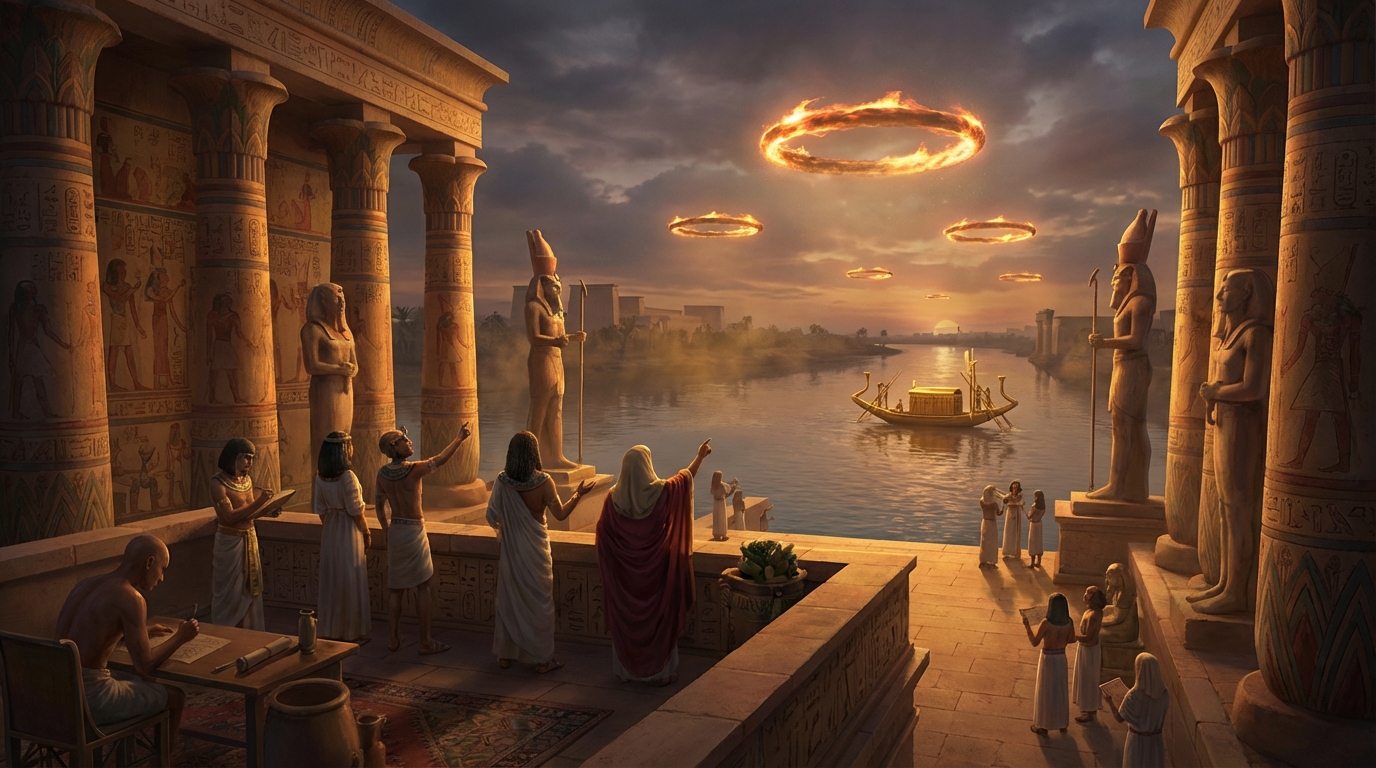
“In the year 22, of the third month of winter, sixth hour of the day… the scribes of the House of Life found it was a circle of fire that was coming in the sky… It had no head. The breath of its mouth had a foul odor. Its body one rod long and one rod wide. It had no voice.”
— Tulli Papyrus, translation by Boris de Rachewitz (1953)The text, as translated by Prince Boris de Rachewitz in 1953 and later analyzed by R. Cedric Leonard, describes what the Egyptian scribes called “circles of fire” appearing in the sky. The account is remarkably specific: the date, the time of day, the physical description. After several days, the phenomena multiplied — “more numerous than anything” — shining in the sky “more than the brightness of the sun.” Fish reportedly fell from the sky. The pharaoh ordered incense burned and the event recorded for the annals. The description is unlike any known Egyptian astronomical record. It does not match descriptions of meteors, auroras, or any recognized atmospheric phenomena in the Egyptian corpus.
The Vatican’s Curious Response
“The papyrus referred to is not property of the Vatican Museum. It is now dispersed and no more traceable.”
— Vatican Museum correspondence, responding to inquiries about the Tulli PapyrusWhen researchers attempted to track down the original papyrus or Tulli’s copy, they encountered a wall of dead ends. After Tulli’s death, his papers were inherited by a relative. The Vatican Museum stated that the document was “not property of the Vatican Museum” and was “now dispersed and no more traceable.” French Egyptologist Étienne Drioton, who reportedly helped Tulli make the original transcription, later acknowledged he had never actually seen the original papyrus himself. What we have, then, is a copy of a copy of a document that no living person can confirm existed — describing an event of profound strangeness in one of the most documented civilizations in history.
The Tulli Papyrus sits in a frustrating liminal space between evidence and absence. We cannot study the original because it has vanished. We cannot verify the transcription because the transcriber is dead and his notes are scattered. We cannot dismiss it outright because the chain of custody — a Vatican Museum director, a French Egyptologist, an Italian prince with genuine academic credentials — is composed of real, credentialed people who had no obvious motive for fabrication. And yet the trail ends in fog.
Skeptics point out, reasonably, that a document surviving only as a copy of a copy, with no provenance and no original, fails the most basic tests of historical evidence. The hieratic text contains grammatical issues that some scholars attribute to copying errors and others to possible fabrication. The fish-falling-from-the-sky detail — while dramatic — has parallels in other ancient texts describing divine displeasure or cosmic disturbance, suggesting it may be a literary convention rather than a literal report.
But consider the alternative reading. If the document is genuine — even partially — it represents an official Egyptian court record of an aerial phenomenon that terrified the scribes of the House of Life badly enough that the pharaoh himself ordered it documented. The specificity of the account is striking: the date, the hour, the physical description, the progression over multiple days. This is not how mythology reads. This is how an incident report reads. An incident report from 1500 BCE, describing luminous objects in the sky that the most advanced civilization of the ancient world could not explain.
The Tulli Papyrus may be nothing. It may be a modern hoax, a chain of honest mistakes, a game of scholarly telephone that produced a phantom document. Or it may be one of the oldest recorded observations of something genuinely unknown in our skies — lost not through conspiracy but through the simple, mundane entropy of paperwork across centuries. The original is gone. The question remains.
Sources & Further Reading
- Boris de Rachewitz — translation and commentary (1953)
- R. Cedric Leonard — analysis and re-translation of the Tulli Papyrus
- Vatican Museum — official correspondence regarding the papyrus
- Étienne Drioton — referenced transcription assistance (correspondence records)
- Samuel Rosenberg — Scientific Study of Unidentified Flying Objects, Condon Report appendices (1969)
- Jacques Vallée — Wonders in the Sky (2010), historical aerial phenomena catalog