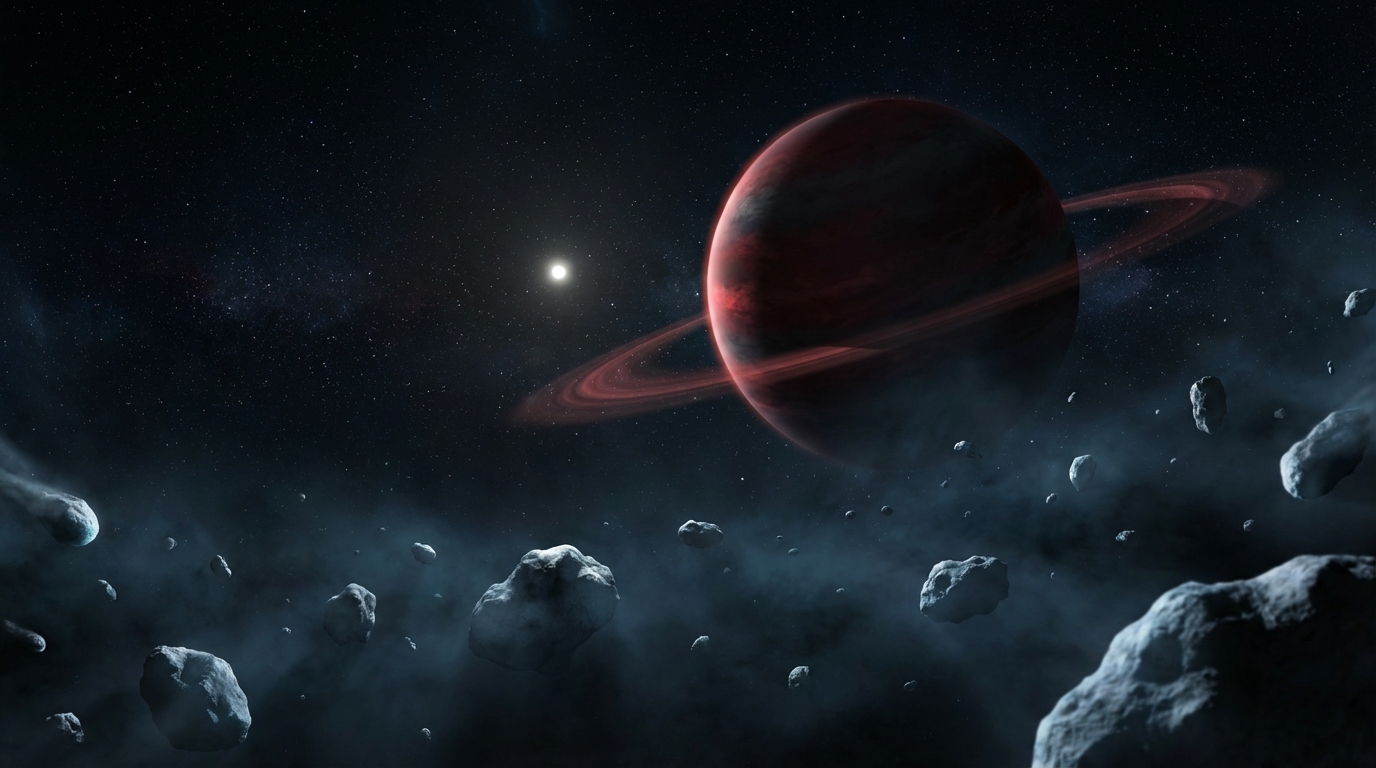
Planet X & Nibiru
The Invisible Giant at the Edge of the Solar System
The Search for Planet X
“There is substantial evidence that the solar system contains a massive, distant planet. Its gravitational influence explains the anomalous clustering of orbits in the outer solar system in a way that no other model has replicated.”
— Konstantin Batygin & Michael Brown, “Evidence for a Distant Giant Planet in the Solar System,” The Astronomical Journal, 2016The search for an unseen planet beyond Neptune is not fringe science — it is one of the oldest pursuits in astronomy. In the 1840s, mathematical predictions of an unseen planet’s gravitational pull led directly to the discovery of Neptune. The same logic drove Percival Lowell to spend the last decade of his life searching for “Planet X” — a hypothetical massive body whose gravity was perturbing the orbits of Uranus and Neptune. Clyde Tombaugh found Pluto in 1930 during this search, but Pluto was far too small to account for the orbital anomalies. The original Planet X remained unfound.
The anomalies were eventually explained by revised mass estimates for the outer planets after the Voyager 2 flyby of Neptune in 1989. The original Planet X hypothesis was retired. But in 2016, Caltech astronomers Konstantin Batygin and Michael Brown published a paper that reignited the search. They found that six distant trans-Neptunian objects share an orbital alignment that has only a 0.007% probability of occurring by chance. The best explanation: a planet roughly five to ten times Earth’s mass, orbiting 400 to 800 AU from the Sun, with an orbital period of 10,000 to 20,000 years. They called it Planet Nine.
Sitchin’s Nibiru
“The Sumerians knew of a planet beyond Pluto. They called it Nibiru, ‘the planet of the crossing.’ It orbits the Sun in a vast elliptical path, returning to the inner solar system every 3,600 years. When it comes, the Anunnaki come with it.”
— Zecharia Sitchin, The 12th Planet, 1976Three decades before Batygin and Brown, the idea of a large undiscovered planet was already a cornerstone of alternative history. In 1976, Zecharia Sitchin published The 12th Planet, arguing that ancient Sumerian texts described a planet called Nibiru on a 3,600-year elliptical orbit that periodically brings it through the inner solar system. According to Sitchin, Nibiru was home to the Anunnaki — the beings described in Sumerian mythology as gods who created humanity as a worker species to mine gold. The Anunnaki, in this reading, were not deities but flesh-and-blood extraterrestrials whose planet’s periodic return explained cycles of catastrophe and renewal in Earth’s ancient past.
Mainstream Assyriology rejects Sitchin’s translations. The Sumerian word “Nibiru” appears in Babylonian astronomical texts, but scholars translate it as a reference to Jupiter, or possibly to the point where Jupiter crosses the ecliptic — not as a twelfth planet. Sitchin had no formal training in Sumerian, and his readings of cuneiform tablets diverge significantly from those of professional translators. His 3,600-year orbital period has no basis in any known Sumerian text. These are serious objections.
The 2012 Panic
“There is no credible evidence — telescopic or otherwise — for the existence of a planet on a collision course with Earth. If such an object were approaching, it would already be one of the brightest objects in the night sky and would be visible to millions of amateur astronomers.”
— NASA, “Beyond 2012: Why the World Didn’t End,” 2012The Nibiru hypothesis took a darker turn in the 2000s when it merged with apocalyptic predictions tied to the end of the Mayan Long Count calendar on December 21, 2012. An internet-driven panic claimed that Nibiru was on a collision course with Earth, or that its gravitational passage would trigger pole shifts, mega-earthquakes, and extinction-level flooding. The hysteria became widespread enough that NASA created a dedicated FAQ page debunking the claims. David Morrison, a senior scientist at NASA’s Astrobiology Institute, reported receiving thousands of letters from frightened people, including teenagers who said they were contemplating suicide rather than face the cataclysm.
The date passed without incident. No rogue planet appeared. The panic discredited the Nibiru concept so thoroughly in popular culture that the legitimate astronomical search for Planet Nine now carefully avoids any association with Sitchin or the 2012 doomsday narrative. This is understandable but also, arguably, a kind of overcorrection. The question of whether a large planet exists in the outer solar system is entirely separate from the question of whether that planet is home to ancient astronauts on a 3,600-year return schedule.
The Orbital Evidence
“The clustering of distant Kuiper Belt objects is not a selection bias artifact. The probability that the observed orbital alignment is random is approximately 1 in 15,000. Something is sculpting these orbits.”
— Michael Brown, interview with Scientific American, 2019As of the mid-2020s, Planet Nine has not been directly observed. But the circumstantial evidence continues to accumulate. Beyond the six objects Batygin and Brown originally identified, additional trans-Neptunian objects have been discovered whose orbits are consistent with the Planet Nine hypothesis. The planet’s predicted mass (five to ten Earths), distance (400–800 AU), and orbital inclination (15–25 degrees to the ecliptic) would make it extraordinarily faint — beyond the reach of most current surveys. The Vera C. Rubin Observatory, expected to begin full operations in the mid-2020s, may have the sensitivity to detect it.
If Planet Nine exists, it raises a genuinely uncomfortable question: how did the ancients know? The Sumerians described a large planet beyond the known solar system thousands of years before telescopes existed. Sitchin’s translations may be wrong, but the Sumerian astronomical tradition was remarkably sophisticated — they catalogued the visible planets accurately, tracked lunar cycles with precision, and their mathematical systems (base-60) still define how we measure time and angles. The gap between “Sitchin mistranslated cuneiform” and “the Sumerians had no knowledge of outer planets” is not as clean as it might appear.
Planet X occupies an unusual space in the landscape of mysteries. It is simultaneously a legitimate astronomical hypothesis backed by peer-reviewed research from Caltech, and a cornerstone of one of the most widely ridiculed conspiracy theories of the internet age. The scientific community’s search for Planet Nine proceeds with careful mathematical modeling, survey strategies, and telescope time. The alternative community’s search for Nibiru proceeds with ancient texts, catastrophe cycles, and the conviction that the establishment knows more than it admits. They are looking for the same thing from opposite directions.
The irony is that if the Vera Rubin Observatory does find a large planet in the outer solar system, both camps will claim vindication — and both will be partially right. The astronomers will be right that it was found through rigorous science. The alternative researchers will be right that something was out there all along, and that the idea was dismissed and mocked for decades before the data caught up. Neither side will agree on what it means.
Sitchin was almost certainly wrong about the details. His translations don’t hold up, his 3,600-year orbit doesn’t match the Planet Nine predictions, and the Anunnaki-as-extraterrestrials narrative requires accepting his readings over those of every professional Assyriologist. But “wrong about the details” is not the same as “wrong about the premise.” If a massive planet is discovered in the outer solar system, the question of how a Bronze Age civilization described its existence will deserve a better answer than coincidence.
Sources & Further Reading
- Batygin, Konstantin & Brown, Michael — “Evidence for a Distant Giant Planet in the Solar System,” The Astronomical Journal (2016)
- Sitchin, Zecharia — The 12th Planet (1976)
- Planet Nine hypothesis — Wikipedia
- Nibiru cataclysm — NASA debunking and cultural history
- Lowell, Percival — original Planet X search (1906–1916)
- Brown, Michael — How I Killed Pluto and Why It Had It Coming (2010)
- Vera C. Rubin Observatory — next-generation survey telescope