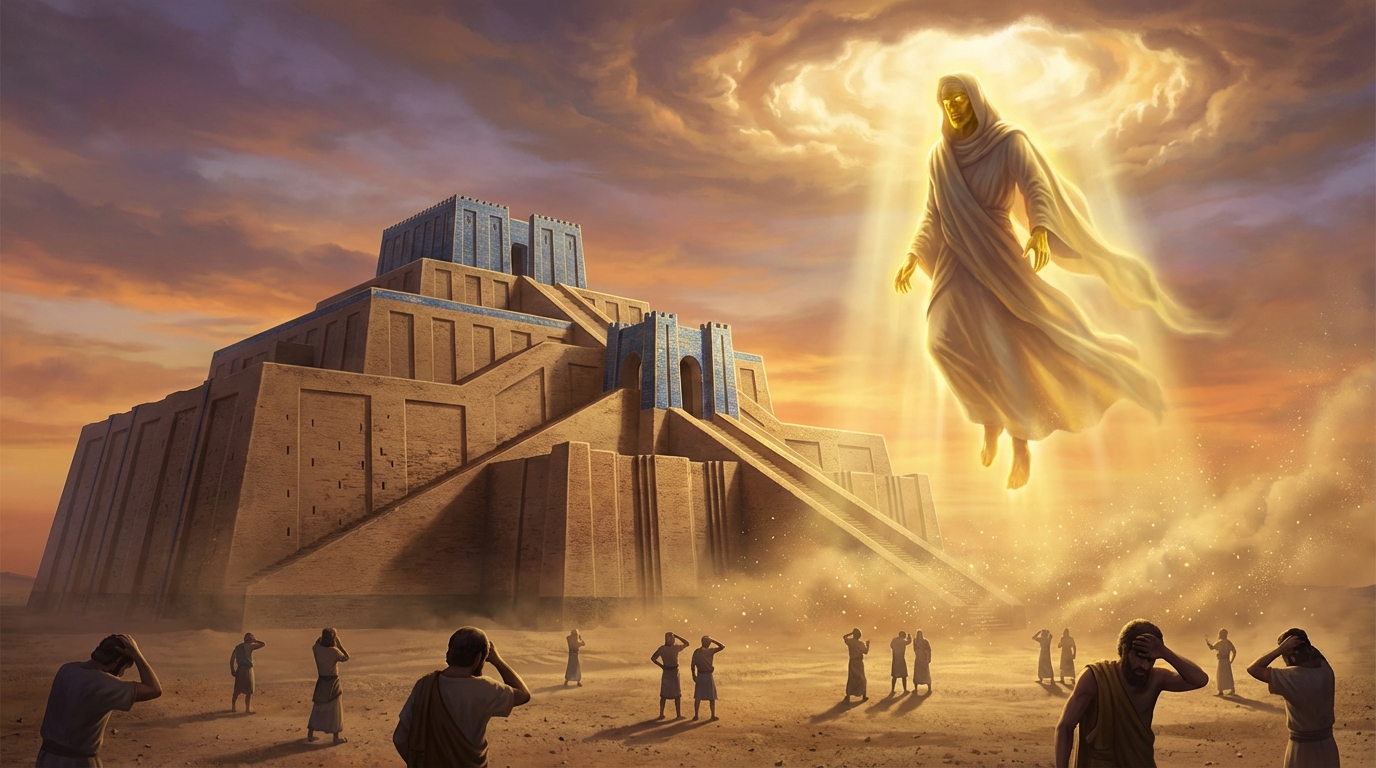
Anunnaki
Those Who From Heaven Came
Zecharia Sitchin and the Twelfth Planet
“The Anunnaki came to Earth approximately 450,000 years ago from a planet called Nibiru, whose elongated orbit brings it close to Earth once every 3,600 years. They came for gold — a metal they needed to suspend in the atmosphere of their own world to preserve it.”
— Zecharia Sitchin, The Twelfth Planet, 1976In 1976, Azerbaijani-born scholar Zecharia Sitchin published The Twelfth Planet, the first volume of what would become the seven-book Earth Chronicles series. Drawing on his own translations of Sumerian, Akkadian, and Babylonian cuneiform texts, Sitchin proposed a radical reinterpretation of ancient Mesopotamian mythology: that the gods described in these texts — the Anunnaki, literally “those who from heaven to earth came” — were not mythological figures at all, but members of an advanced extraterrestrial civilization from a planet called Nibiru.
According to Sitchin, Nibiru follows a highly elliptical orbit that carries it through the outer solar system, returning to the inner planets approximately every 3,600 years — a period the Sumerians called a sar. The Anunnaki first arrived on Earth roughly 450,000 years ago, establishing bases in Mesopotamia and southern Africa. Their purpose was practical: mining gold, which they needed in particulate form to repair the deteriorating atmosphere of their home world. Academic Sumerologists have challenged Sitchin’s translations at virtually every turn. But his books have sold millions of copies in dozens of languages, and the questions he raised about the content of the world’s oldest texts remain provocative regardless of whether his specific answers are correct.
The Creation of Humanity
“Let us create a Primitive Worker, that he may bear the yoke. Let him carry the toil of the gods.”
— From the Atra-Hasis, Babylonian creation epic, circa 1700 BCEThe Sumerian and Babylonian creation texts describe something that reads less like mythology and more like a project report. The lesser gods — the Igigi — had been assigned the labor of mining and canal-building. After 3,600 years of toil, they revolted, burning their tools and surrounding the dwelling of Enlil, the chief administrator. In response, the god Enki (lord of wisdom and water) proposed a solution: create a new being to take over the labor. Working alongside the birth goddess Ninhursag, Enki mixed the “clay” — which Sitchin interprets as the genetic material of an existing hominid — with the blood and essence of a slain god. The result was the lulu, the “mixed one” — humanity.
The parallels between this narrative and the account in Genesis are striking and well-documented by mainstream scholars. God forming man from the dust of the ground and breathing life into him; the Garden of Eden as a bounded, maintained space (the Sumerian E.DIN); the creation of woman from a “rib” (in Sumerian, the word ti means both “rib” and “life”); the great flood and the instruction to build an ark — Genesis appears to be a compressed, monotheistic retelling of stories that the Sumerians wrote down a thousand years earlier in far greater detail. The question is not whether the parallels exist. They do. The question is what they mean.
The Flood and the Epic of Gilgamesh
“The gods smelled the savor. The gods smelled the sweet savor. The gods gathered like flies around the sacrifice. But Enlil was furious when he arrived — ‘How did any living being survive? No man was to live through the destruction!’”
— Epic of Gilgamesh, Tablet XI, circa 2100 BCEThe flood narrative in the Epic of Gilgamesh predates the biblical account of Noah by at least a millennium and contains details so specific they read less like allegory and more like reportage. The hero Utnapishtim is warned by the god Enki (who defies the ruling council’s decree of silence) that a devastating flood is coming. He is instructed to build a vessel of specific dimensions, seal it with bitumen, and bring aboard his family, craftsmen, and “the seed of all living things.” The storm lasts seven days. The vessel comes to rest on a mountain. Birds are released to find land. The parallels to Genesis 6-9 are not approximate — they are nearly identical in structure.
Within Sitchin’s framework, the flood was a natural catastrophe caused by the gravitational effects of Nibiru’s passage through the inner solar system, which destabilized the Antarctic ice sheet and triggered a global deluge. The ruling Anunnaki, led by Enlil, decided to let humanity perish — to solve the “noise” problem of their overpopulated creation. But Enki, who had designed humanity and felt responsible for it, secretly warned Utnapishtim. The tension between Enki and Enlil — between the creator who loves his creation and the administrator who sees it as a problem — forms the emotional spine of the entire Anunnaki narrative. It is also, arguably, the oldest story about the relationship between gods and mortals that we possess.
The Anunnaki occupy a unique position in the taxonomy of alleged alien species. They are not drawn from modern UFO encounter reports or abduction literature. They emerge instead from the oldest stratum of human writing itself — from the cuneiform tablets of Sumer, the civilization that invented writing, mathematics, astronomy, law, and urban planning in the fertile plains between the Tigris and Euphrates rivers roughly five thousand years ago. When these people first pressed stylus to clay and recorded their understanding of where they came from, they wrote about gods who descended from the sky, established cities, and created humanity to serve them. Whatever else we make of this, it is what they wrote. It is the first thing anyone ever wrote.
Sitchin’s interpretation is controversial, and deservedly so. His translations have been challenged by professional Sumerologists, his astronomical claims about Nibiru lack observational support, and his timeline requires a version of human evolution that conflicts with the fossil record. These are real objections. But the texts themselves are real too, and they contain elements that are genuinely difficult to explain as pure mythology. The Sumerians described the solar system as having more planets than were visible to the naked eye. They knew that Pluto was “watery” — something not confirmed until the New Horizons mission in 2015. Their mathematical system was sexagesimal (base-60), from which we inherit our 60-second minutes and 360-degree circles. The question of how a civilization that had only just invented the wheel could also produce astronomical knowledge of this precision has never been satisfactorily answered.
The Enki-Enlil dynamic at the center of the Anunnaki narrative resonates with a depth that transcends any single interpretation. Enki, the scientist-creator who loves humanity and repeatedly acts to preserve it against the wishes of the ruling council. Enlil, the administrator who views humanity as a tool that has outlived its usefulness. Between them, every fundamental question about the relationship between creator and creation is posed: Does a created being have rights? Does the creator bear responsibility? What happens when the tool develops consciousness, desire, and will? These are not primitive questions. They are the questions we are asking right now about artificial intelligence, about genetic engineering, about every form of life we create and then must decide what to do with.
Whether the Anunnaki were real beings from a planet called Nibiru, or whether the Sumerians encoded advanced philosophical and astronomical knowledge in the form of personified narratives, or whether the truth is something stranger than either of these options, the tablets remain. They sit in museums in Baghdad, London, Philadelphia, and Berlin. They can be read. They describe, in meticulous detail, beings who came from elsewhere, created humanity through a process that sounds unsettlingly like genetic engineering, divided among themselves about what humanity deserved, and eventually departed — promising, or threatening, to return.
The oldest writing on Earth tells a story about beings who came from the sky and made us. That is not a modern conspiracy theory. It is not a fringe interpretation. It is the literal content of the oldest documents in human history, written by the people who invented documents. We can argue about what it means. We cannot argue about what it says.
Further Reading
- Zecharia Sitchin, The Twelfth Planet (1976) & the Earth Chronicles series
- Samuel Noah Kramer, The Sumerians (1963)
- The Enuma Elish (Babylonian creation epic)
- The Atra-Hasis (Babylonian flood & creation narrative)
- Epic of Gilgamesh, Tablet XI (flood account)